Research by Thomas Kimman (UMC Utrecht) provides new insights into intrinsic tumor resistance mechanisms, and presents innovative strategies using CAR T cells to deliver pro-apoptotic or immunogenic cell death-inducing proteins to tumor cells. These studies mark a step forward in overcoming resistance and advancing the next generation of CAR T cell therapies.
Chimeric antigen receptors (CAR) T cell therapies have already demonstrated favorable clinical outcomes in cancer treatment, although tumor resistance mechanisms remain a major obstacle. The PhD thesis of Thomas Kimman (Peperzak Lab, Center for Translational Immunology, UMC Utrecht) focused on the primary function of CAR T cells in cancer therapy: the mechanisms by which they kill tumor cells. By gaining a fundamental understanding of how CAR T cells induce tumor cell death and how tumors resist this cytotoxicity, researchers will be able to design new strategies to overcome resistance while avoiding systemic side effects.
Thomas Kimman defending his PhD thesis
One of the mechanisms by which CAR T cells eliminate tumor cells is through the release of cytotoxic granule contents into the target cell. The key effector protein that induces regulated cell death (apoptosis) is granzyme B. In human biology, the protein Serpin B9 is known as a specific inhibitor of granzyme B. Research by Thomas Kimman and colleagues identified Serpin B9 as a novel intrinsic resistance mechanism to CD19- and CD20-directed CAR T cell therapy.
Previous preclinical studies have shown that inhibition of MCL-1 (an anti-apoptotic protein associated with tumor growth) can effectively eliminate multiple myeloma (MM) cells. However, clinical trials have revealed severe systemic toxicity associated with MCL-1 inhibition, halting further clinical development. To make this potentially effective strategy feasible, scientists investigated synergistic combinations of clinically available agents. In his PhD research, Kimman demonstrated that concomitant inhibition of MCL-1 and P70S6K1 (an enzyme associated with tumor growth) has a synergistic effect, thereby allowing treatment with lower doses of MCL-1 inhibitors and minimizing adverse effects.
As a major part of his research project, Kimman explored innovative methods to specifically target MCL-1 in MM. To this end, he developed a strategy to express the MCL-1 antagonist NOXA within the cytotoxic granules of BCMA-targeted CAR T cells. He showed that NOXA can be directed to the granules by fusing it to granzyme B. Upon recognition of an MM cell, NOXA is released into the tumor cell. This arming of BCMA CAR T cells with a pro-apoptotic NOXA, enhances their antitumor activity. In addition, they also revealed MCL-1 expression by MM cells as a CAR T resistance mechanism.
Furthermore, Kimman described an international patent filing related to fusion proteins based on the NOXA scaffold. In this approach, the effector BH3 domain of NOXA can be exchanged with BH3 domains from other pro-apoptotic BCL-2 family proteins. This design could support personalized therapies with engineered CAR T cells tailored to tumor-specific dependencies on survival proteins.
Cytotoxic T cells mainly induce apoptosis. This clean form of cell death does not release inflammatory mediators such as damage-associated molecular patterns (DAMPs). Thomas Kimman and co-workers took the first steps toward using the ‘CARgo’ delivery method to induce immunogenic cell death in vitro. They anticipated that inducing an immunogenic form of tumor cell death could shift the balance in favor of tumor-clearing CAR T cells, especially in solid tumors where T cell infiltration is limited.
Thomas Kimman concluded: “Collectively, my thesis provides new insights into intrinsic tumor resistance mechanisms, and presents innovative strategies using CAR T cells to deliver pro-apoptotic or immunogenic cell death-inducing proteins to tumor cells. Together, these studies mark a step forward in overcoming resistance and advancing the next generation of CAR T cell therapies.”
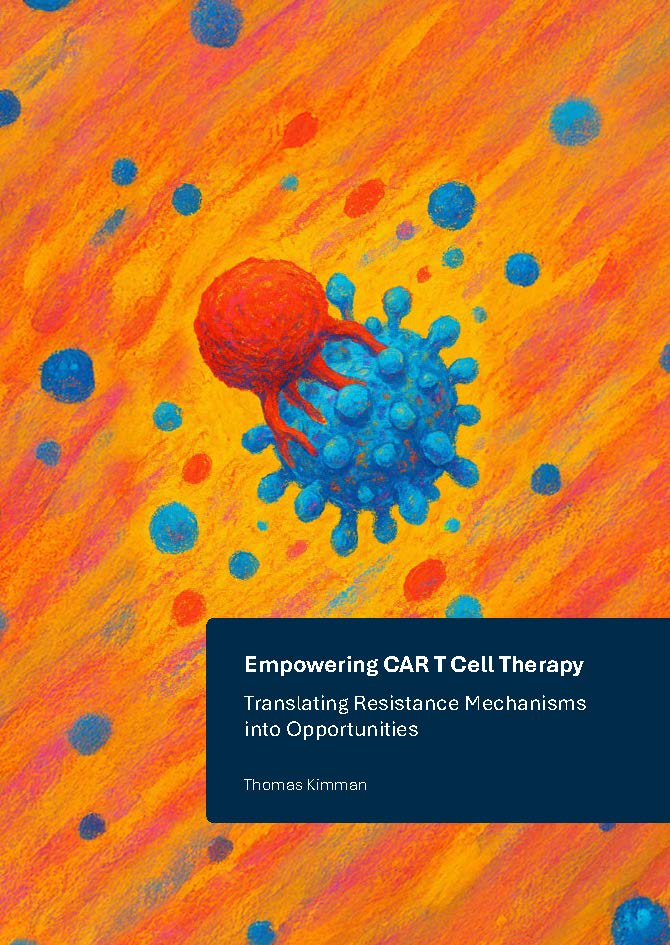
Thomas Kimman, MSc (1987, Amsterdam) defended his PhD thesis on January 7, 2026, at Utrecht University. The title of his thesis was “Empowering CAR T Cell Therapy – Translating Resistance Mechanisms into Opportunities.” Supervisors were Prof. Monique Minnema, MD PhD (Department of Hematology, UMC Utrecht) and Prof. Jürgen Kuball, MD PhD (Department of Hematology and Center for Translational Immunology, UMC Utrecht). Co-supervisors were Victor Peperzak, PhD and Zsolt Sebestyén, PhD (both Center for Translational Immunology, UMC Utrecht).