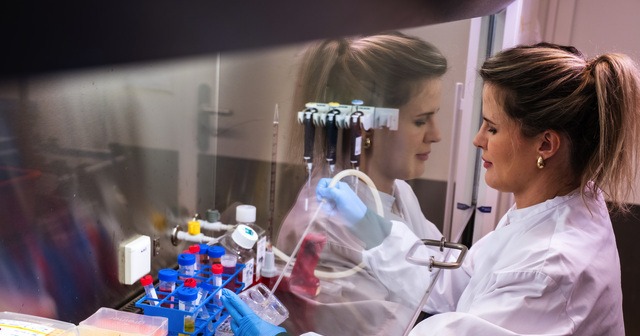
Researchers at UMC Utrecht are working on a promising new form of immunotherapy for cancer. This involves a relatively unknown type of immune cell that can be used in multiple patients simultaneously. These gamma-delta T cells offer the prospect of more effective and affordable treatments.
Our immune system consists of cells that travel through our body, protecting us against infections and clearing away diseased cells. One of these types is the T cell. It has long been known that T cells are not only good at clearing away pathogens—they can also recognize and clear away tumors.
Boost for the immune system
The first cancer treatments based on T cells are now a reality. In this so-called CAR T cell therapy, T cells are extracted from a patient’s blood and genetically modified in the lab, where they are equipped with receptors that can recognize cancer cells. These receptors, known as CARs (chimeric antigen receptors), give CAR T cell therapy its name. They enable the T cells to recognize pieces of protein from tumor cells, after which they trigger the T cells into action: clearing the tumor cell. Unlike chemotherapy, which affects all rapidly dividing cells in the body, these T cells only attack the tumor.
The most used T cells for cancer treatments are the so-called alpha-beta T cells. But there is also another subtype, the so-called gamma-delta T cell. Scientists at UMC Utrecht, led by Jürgen Kuball, are conducting research into this lesser-known type of T cell and its potential to recognize and eliminate tumor cells. These scientists recently published a scientific article, emphasizing the importance of research into gamma-delta T cells.
Presentation tray
Their research shows that the difference between alpha-beta T cells and gamma-delta T cells is the way in which they recognize their target. Alpha-beta T cells recognize proteins that are part of the so-called HLA complex. This is a protein structure that displays foreign protein fragments on the cell surface like a kind of presentation tray. Alpha-beta T cells ‘see’ these protein fragments as foreign before they respond. Because HLA complexes differ from person to person, a patient cannot be treated with someone else’s alpha-beta T cells, as the donor T cells may attack the patient’s tissues. This phenomenon occurs in stem cell transplants and is known as graft-versus-host disease.
“Gamma-delta T cells work in a fundamentally different way,” says Dennis Beringer, co-researcher from Jürgen Kuball’s group. “They do not respond to the HLA complex, but to stress signals that arise when a cell goes haywire, for example in cancer. Because these signals are transmitted via the same proteins in everyone, gamma-delta T cells can in principle be used in different patients. Moreover, the cells do not cause graft-versus-host disease.”
Extra receptor
Nevertheless, clinical studies with gamma-delta T cells have yielded few positive results so far. Researchers do not yet fully understand what these cells need to remain active in the body for a long time. That is why they are actively looking for ways to enhance the functioning of gamma-delta T cells. They do that, for example, by providing them with an additional CAR recognition receptor. These CAR gamma-delta T cells have a strong response against tumor cells. That way, they can be used in more than one patient at the same time. This could potentially save time and money.
“Currently, CAR T-cell therapies involve extracting T cells from each individual patient’s blood, genetically modifying them, and then returning them to the patient,” says Trudy Straetemans, co-researcher in Jürgen Kuball’s group. “This is far from ideal: some of these productions fail and cannot be scaled up. That makes production expensive and labor-intensive. In the field of gamma-delta T cells, the greatest promise lies in the scalability of production.”
The best of both worlds
Another way to utilize the unique properties of gamma-delta T cells is to use their receptors in alpha-beta T cells. “Some tumors are undetectable by alpha-beta T cells, but we can find them with gamma-delta T cells,” says lead researcher Jürgen Kuball.
In recent years, Kuball and his colleagues have improved this hybrid cell, known as the TEG product (T cell receptor Engineered into Gamma-delta T cells), by introducing costimulation: the principle that an extra receptor on the T cells causes a stronger response, like turning up a volume knob. “In recent research, we have shown that by adding costimulation to the TEG product, we were able to demonstrate much better tumor control.” This was not only the case in a test tube, but also in animal models. “To our great surprise, the animals even remained tumor-free,” says Kuball. “We had never seen that before with previous TEG products.”
Clinical next steps
The next step is to take the cells from the laboratory to the clinic. For that to happen, the cells must first be able to be produced cleanly and safely. This optimization step is made possible thanks to Oncode Accelerator and DareNL. But aside from that, more research is needed before the real first step in the clinic can be taken, says fellow researcher Zsolt Sebestyen. “Because gamma-delta T cells recognize the body’s own proteins, the newly developed TEG therapy with costimulation could be so potent that it also attacks healthy cells.” That is why the researchers are testing their new product against various healthy tissues in the laboratory. “Once we demonstrate that our new TEG product is safe based on these experiments, we naturally hope to be able to measure a tumor response in patients.”
If all goes well, the researchers expect that patients will be able to receive the latest generation of TEG therapy in a study setting within a few years. This would herald a new type of cell therapy that is broader in application, safer, and more affordable than current cell therapies.