For people with severe focal epilepsy, surgery can offer the chance of a life free from seizures. During these procedures, surgeons record the brain’s electrical activity for only a few minutes to help guide the operation as accurately as possible. PhD research by Eline Schaft shows how advanced recording and analysis techniques can extract more valuable information from these signals, potentially improving surgical outcomes and supporting more personalized epilepsy care.
In focal epilepsy, seizures originate in a specific area of the brain. When medication fails to provide sufficient results, surgery may be an effective treatment option. During the procedure, surgeons place electrodes on the surface of the brain to record its electrical activity. This information helps guide surgical decisions and improve precision.
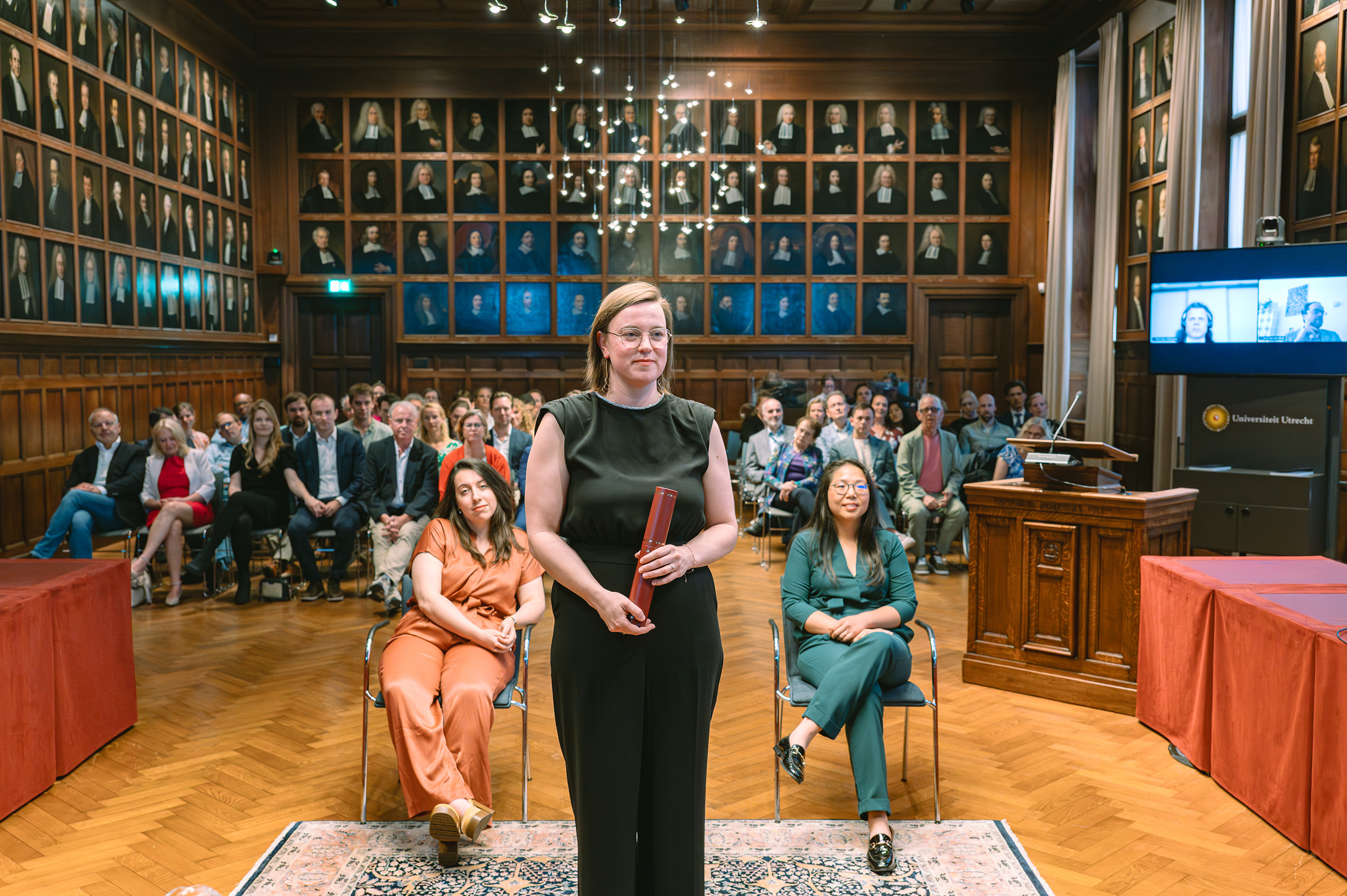
Because these recordings typically last only a few minutes, it is important to extract as much information as possible from the signals. The PhD research of UMC Utrecht doctoral candidate Eline Schaft demonstrates just how much valuable information is hidden within these brief recordings. She defended her research on the 4th of June.
One of the methods Schaft used to analyze this information is called spectral entropy. Rather than focusing on individual peaks in a signal, this technique evaluates all of the information contained within it.
Using this approach, researchers were better able to distinguish between brain regions involved in epilepsy and those that were not.
“Ultimately, you want to be able to assess each piece of brain tissue and determine whether it is involved in epilepsy or not,” Schaft explains. “This type of analysis helps make that distinction more accurately.”
She also found indications that the same analytical approach may help predict surgical success. By comparing signals recorded before and after brain tissue was removed, she observed differences between patients who later became seizure-free and those whose seizures returned.
In addition to developing new analytical methods, Schaft investigated a new generation of electrode grids for use during epilepsy surgery. A standard grid contains 16 to 20 electrodes. The new grid includes 64 electrodes within the same surface area. “Our first question was whether it would even be possible to effectively review that many signals during surgery,” says Schaft. “Surprisingly, it worked very well.”
The higher electrode density allows surgeons to examine brain regions in greater detail and detect signals that may remain hidden between conventional measurement points. “We are collecting far more signals from the same area of the brain. As a result, we can identify patterns that might be missed with standard recordings.”
Ultimately, these new recording and analytical methods are intended to improve outcomes for epilepsy surgery. By more accurately identifying the brain tissue responsible for seizures, surgeons can make better decisions about what tissue should and should not be removed. “We hope that in the future we will be able to remove less healthy brain tissue while still achieving seizure freedom for patients,” says Schaft.
The findings also create opportunities for more personalized care. The better physicians can predict a patient’s likelihood of becoming seizure-free, the better they can prepare that individual for what to expect after surgery. Medication management and follow-up care can also be tailored more effectively to each patient.
“The more information we can extract from these signals, the better we can tailor treatment to the individual patient,” Schaft emphasizes. “That is ultimately what we are working toward.”