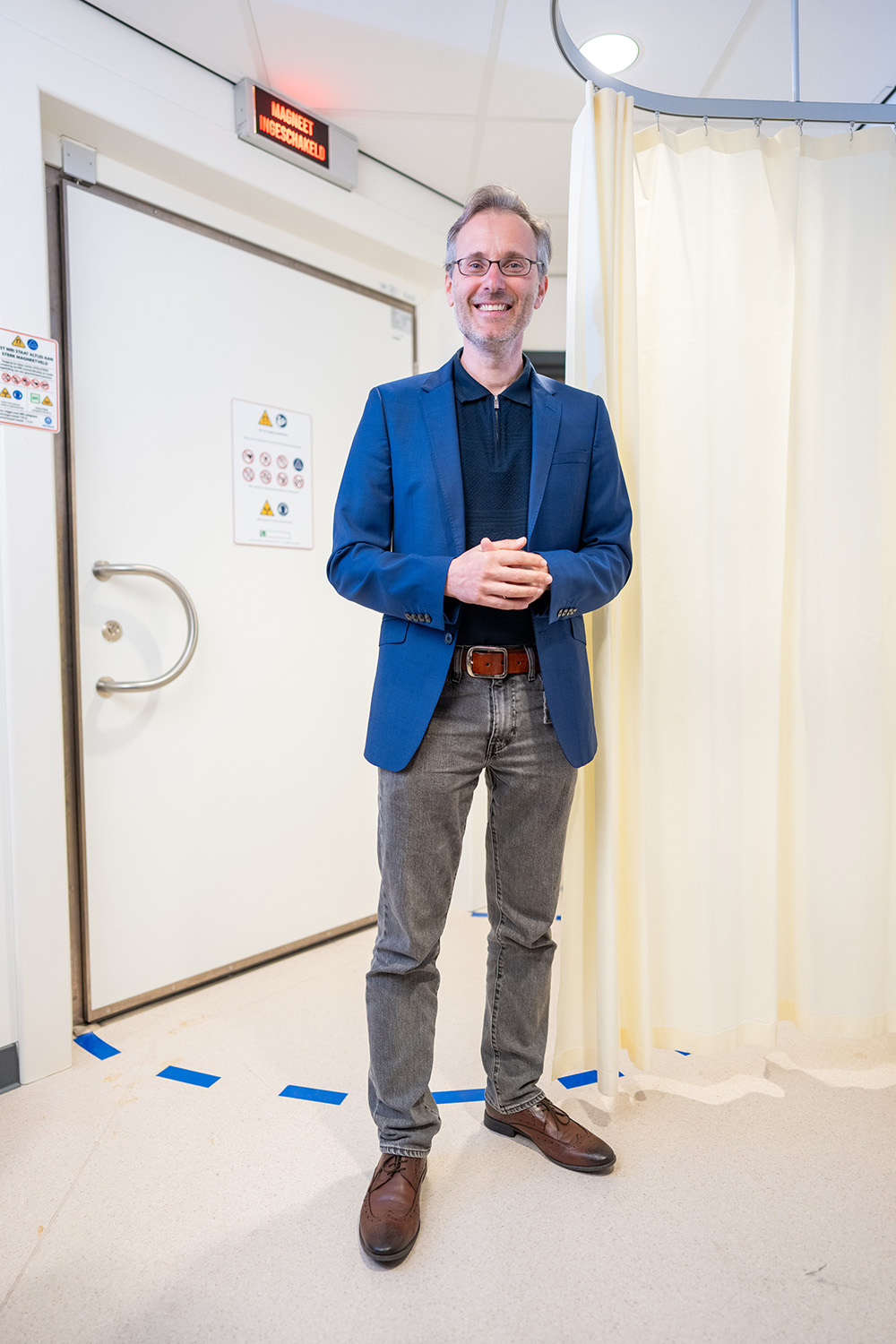
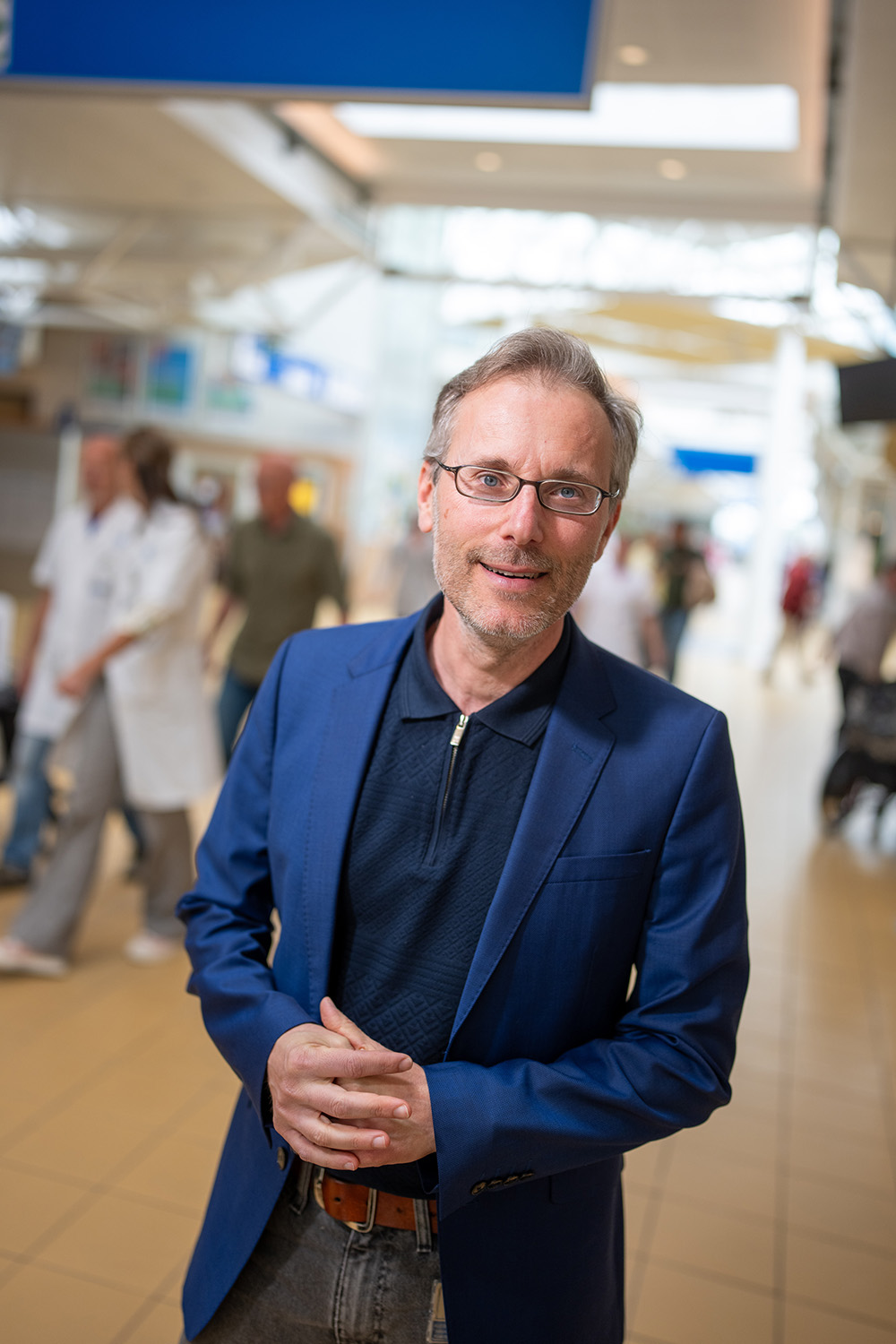
Are there only ‘white coats’ working at UMC Utrecht? Certainly not. Mathematician Alessandro Sbrizzi, for example, ensures that doctors can use MRI scanners to see more quickly and precisely what is wrong with someone, in order to be able to treat people better.
An MRI scan provides a lot of information about the body. But recording the data via such a scan often takes a lot of time. Alessandro Sbrizzi develops computational methods that ensure that MRI scans take less time and provide even more information. He does this, among other things, with advanced mathematical models, which he combines with AI.
The goal of Alessandro’s research: more precise images, more information about how organs function, shorter scan times and better support for doctors in making medical decisions. As of 15 July 2026, Alessandro has been appointed professor of ‘Computational methods for diagnostic and therapeutic imaging’.
“With my research, I try to bridge the gap between theoretical models and applications on the hospital floor,” says Alessandro. “We want to develop technology that really makes a difference for patients and healthcare professionals.”
Less time in the scanner
The demand for medical images continues to grow, while the pressure on healthcare is increasing. Alessandro’s research helps to tackle this problem. His team focuses on improving the accuracy of the scans, but also on shortening MRI examinations and reducing the costs of medical imaging.
One of the best-known innovations of Alessandro and his team is MR-STAT: a technique that can extract a lot of information from an MRI scan in a shorter period of time. While an extensive MRI scan now often takes about 25 minutes, it may be shortened to less than five minutes with MR-STAT.
This offers advantages for both patients and healthcare professionals. Shorter scan times mean less strain on patients. This will make a big difference, especially for children, the elderly or people who have difficulty lying still.
Capacity within hospitals also improves due to a shorter scan time: the same staff can help more people in the same time.
“By reducing scan times and making processes smarter, we aim to make MRI more accessible to more people,” says Alessandro. “At the same time, we are improving the quality of diagnostics: doctors can collect more and more precise information to determine what is going on and make a better treatment plan.”
The MR-STAT technique is now being investigated during clinical studies with people suffering from cancer, epilepsy, strokes, Parkinson’s and multiple sclerosis, among others.
Scanning a moving patient
In addition to rapid MRI, Alessandro is working on methods to correct a patient’s movements during scans and to make the dynamics of internal organs (such as the beating heart) more visible. This is an important challenge in medical imaging. Even small movements of a patient can make MRI images less sharp. At the same time, however, more information about how organs move helps to get a better diagnosis.
Using techniques, such as MR-MOTUS, Alessandro’s research group develops ways to track movement in real time and to study and/or correct it. While doing so, doctors can, for instance, see if the heart is doing its job properly.
MR-MOTUS can also provide sharper and more useful information for diagnosis and possible treatment, even if someone is not lying still during the examination.
This is important, for example, in image-guided radiotherapy with the MR-Linac. With this device, doctors are able to irradiate tumors very precisely. To do so, they must be able to properly monitor the position of the tumors in moving body parts. But the techniques developed by Alessandro also have great advantages while making MRI scans of children.
“One of our goals is to make MRI without anesthesia possible for children,” says Alessandro. “With smart algorithms (computer calculation models – ed.) we can correct movements and still make good images.”
Within the Wilhelmina Children’s Hospital (WKZ) and the Princess Máxima Center (PMC), he is therefore working with researchers and doctors on child-friendly MRI techniques.
“We want to develop technology that really makes a difference for patients and healthcare professionals”
AI as support for doctors
AI is playing an increasingly important role in medical imaging, including in Alessandro’s work. His mathematical models are often linked to machine learning: a form of AI in which computer systems learn from data and can make accurate predictions by recognizing patterns in that data.
Alessandro’s research group develops algorithms for, among other things, standardizing MRI data, so that AI systems learn better from the images provided by different hospitals and scanners.
“AI can help to validate medical decisions,” says Alessandro. “But it must always be in line with daily hospital practice and reliable for patients and healthcare professionals.”
Alessandro and his team are also investigating how AI can contribute to more personalized treatments for people with cancer, for example by predicting how effective a particular therapy will be and what side effects may occur.
Connection between disciplines
Alessandro’s new chair shows how much collaboration between various disciplines is needed to realize innovations in healthcare. Within his work, mathematics, computer science, physics, radiology, oncology and AI come together.
Alessandro works closely with colleagues within UMC Utrecht, Utrecht University and international partners, among others.
Within UMC Utrecht, Alessandro’s team joins forces with various departments and specializations. Think of Radiology, Radiotherapy, Neurology, Cardiology and the WKZ.
Through this close way of working together, science, technology and healthcare reinforce each other to develop solutions for the healthcare of the future.
“Healthcare is a complex system. Not only are the components and instruments (think of the MRI, for example) complex, but so is the interaction between patients, healthcare providers and the various components (such as diagnostics and treatment),” says Alessandro.
“Moreover, everything has to do with people’s lives, so risk plays a major role continuously. For this reason, mathematics is often used in healthcare, and for an applied mathematician like me this is very interesting. Furthermore, It’s important to always keep the societal impact in mind.”
From organist to professor
Alessandro’s career is special. Before focusing entirely on medical imaging, he studied organ in his native Italy and then at the conservatory in Utrecht. For ten years, he was a full-time musician. Only then did he decide to study mathematics at Utrecht University. In 2013, he obtained his PhD in MRI technology at UMC Utrecht, and has continued to work here.
He himself does not find the combination of music and mathematics special at all, but logical and valuable. “Both music and mathematics require creativity, discipline and a sense of structure,” he explains.
Since 2015, he has been an assistant professor and then an associate professor at UMC Utrecht. He now leads the Computational Imaging group here, together with Nico van den Berg, professor of ‘Computational imaging for MRI therapy and diagnostics’. This group consists of researchers and PhD students who are working on new techniques for MRI and other medical imaging.
“I am part of a talented interdisciplinary team that, despite the different backgrounds and expertise, still functions as an organic whole,” says Alessandro.
Training new researchers
In addition to research, education plays an important role in Alessandro’s work. He teaches students, supervises PhD students and young researchers. He lectures about scientific computing, machine learning and MRI technology.
He also shares his knowledge internationally, through lectures at major conferences on MRI and medical imaging. Within his research group, he also encourages researchers to actively exchange knowledge and help each other further.
“Training young researchers is essential,” he says. “Innovation is created by working together and sharing knowledge across disciplines and generations.”
Building the image of tomorrow
Alessandro’s appointment strengthens UMC Utrecht’s position as an international center for innovative imaging and AI in healthcare.
In the coming years, he wants to further expand his research and develop new applications for MRI and other imaging techniques, such as CT and ultrasound. For him, the societal impact remains central.
“My ambition is to make medical imaging faster, more accurate, more informative and more accessible,” says Alessandro. “By making smart use of computational methods and AI, we can contribute to better healthcare and better outcomes for patients.”
Alessandro in short
Alessandro Sbrizzi (1976, Friuli (Italy)) studied organ, composition and harpsichord at the conservatories in Udine (Italy), Utrecht and Essen (Germany) and became a finalist and prize winner of organ competitions in Rome, Amsterdam and Dublin.
He then studied mathematics at Utrecht University.
There he obtained his PhD in 2013 on medical imaging with MRI: Concerto per MRI: a mathematical orchestration of RF fields for pTx systems.
After that, Alessandro continued to work as a researcher at UMC Utrecht.
In 2015, he became an assistant professor, and in 2019 an associate professor.
He has been appointed as a professor as of mid-July 2026.
His chair falls within UMC Utrecht’s themes of Cancer, Circulatory Health and Child Health, and the Life Sciences theme of Utrecht University.
Alessandro lives in Utrecht with his wife Ying Lai and son Lorenzo (3).
Why a full-time mathematician and not a full-time musician?
“I worked as a full-time musician for ten years and started studying mathematics at the age of 30 as a kind of hobby, in addition to my work in music. When I did my master’s graduation project at UMC Utrecht, I realized how rich and complex the combination of theory and practice in MRI is. I wanted to get more serious about this. That opportunity came in the form of a PhD project. The switch to full-time mathematics was not a difficult or sudden decision: everything evolved quite naturally. But making music is still an important part of my life.”