Recognize patients with serious spinal metastases earlier and in time. A new referral tool developed by UMC Utrecht is designed to help physicians do just that. By enabling earlier recognition, unnecessary suffering and complex, costly emergency surgeries can be prevented.
The new tool was developed by researchers and spine specialists at UMC Utrecht. It consists of a series of questions that quickly assess the severity of a patient’s condition. The world’s largest international network of spine specialists (AO Spine) has now adopted the tool, helping patients around the world receive the right medical care sooner. The researchers have published their findings in the European Journal of Cancer.
Jorrit-Jan Verlaan, professor of mobility in spinal metastases at UMC Utrecht and the creator of the tool, explains: “It helps physicians who are not spine specialists to make the right decision more quickly. This may help prevent serious complications, such as permanent neurological deficits or paralysis.”
From monitoring to referral
Every year, millions of people worldwide develop cancer that has spread to the spine. In some patients, these metastases compress the spinal cord or make the vertebrae unstable. In such cases, rapid treatment is essential. However, for physicians outside the field of spine surgery, accurately assessing the severity of the situation is not always straightforward.
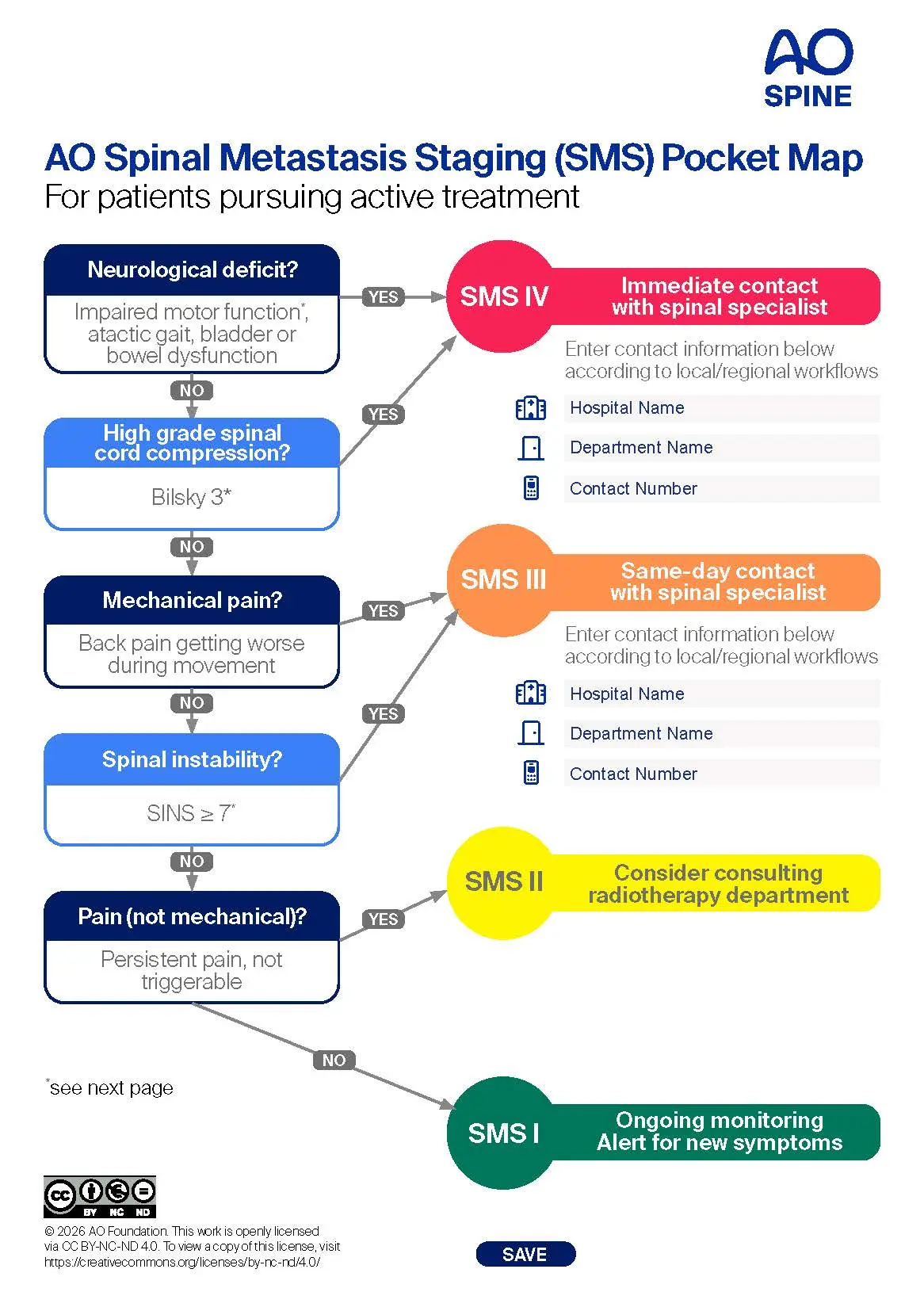
The new Spinal Metastasis Staging (SMS) decision support tool changes that. Based on a few simple questions about symptoms, neurological deficits, and imaging findings, the tool determines the level of urgency. Each outcome is linked to a clear recommendation, ranging from continued monitoring to immediate referral to a spine specialist.
“Let’s make sure patients are seen in time, and let’s start doing that today.”
Available to physicians worldwide
“The decision support tool ensures that physicians use the same language when assessing patients with spinal metastases. This reduces the risk that patients are referred to a specialist too late,” says Jorrit-Jan Verlaan.
The tool is available free of charge through AO Spine. Physicians can use the digital version or download a compact pocket card for use on the ward or while on call. The digital version can also be customized, for example by adding regional referral pathways and contact details for specialized centers.
International collaboration
The decision support tool was conceived at UMC Utrecht and further developed under the leadership of Jorrit-Jan Verlaan in collaboration with regional (Oncomid) and national experts. The AO Spine Knowledge Forum Tumor, an international collaboration of specialists in spinal tumors, also played a key role in the development and worldwide dissemination of the tool.
The researchers are currently conducting an international follow-up study to scientifically evaluate the tool’s usability and impact in daily clinical practice. “Nearly half of all patients who undergo surgery for spinal metastases are admitted as emergency cases,” says Jorrit-Jan Verlaan.
“By that time, their symptoms are often already advanced. The outcomes of emergency surgery are considerably worse than if we had been able to intervene earlier, and less invasively. Let’s make sure these patients are seen in time, and let’s start doing that today. This decision support tool can help us do exactly that.”
How does the SMS system work?
The Spinal Metastasis Staging (SMS) decision support tool consists of four yes/no questions that guide treating physicians who are not spine specialists. Based on the answers, they’ll immediately know whether and to whom referral is necessary. There are four possible outcomes:
SMS IV: Refer immediately to a spine specialist.
SMS III: Contact a spine specialist the same day for consultation.
SMS II: Consider referral to a radiation oncologist.
SMS I: No immediate action required; continue monitoring the patient and remain alert for new symptoms.