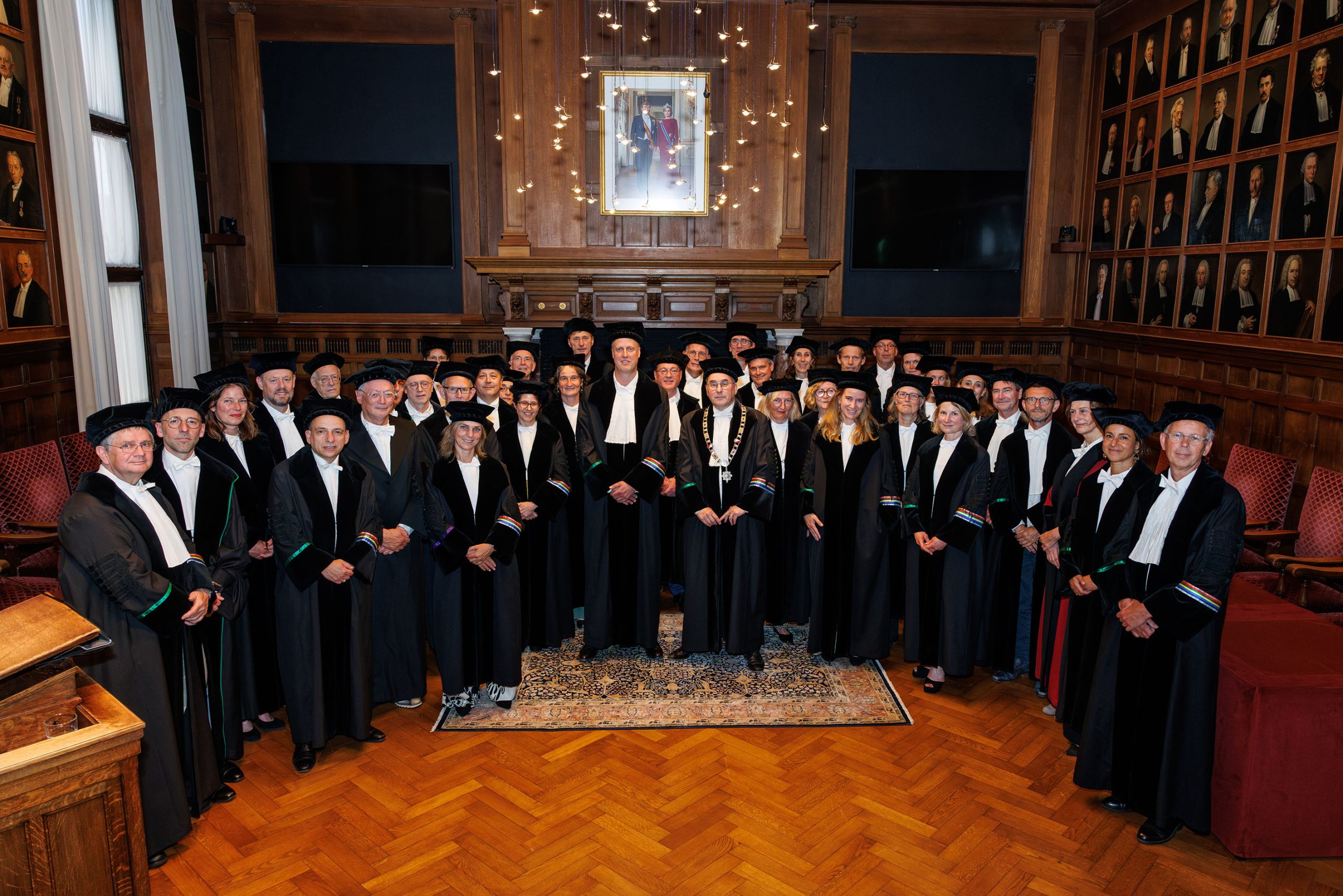
Chronic pain is often invisible, yet it shapes the daily lives of millions of people. Worldwide, one in five adults experiences chronic pain. During his inaugural lecture on May 28, Niels Eijkelkamp, Professor of Neuroimmunology of Pain at Utrecht University and UMC Utrecht, explained why chronic pain is much more than a symptom of disease. In his lecture, Beyond the Boundaries of Pain, he argued for a fundamentally different way of understanding and treating pain.
“Traditionally, chronic pain has been viewed as a warning signal: treat the underlying disease and the pain will disappear.” According to Prof. Niels Eijkelkamp, this idea still underpins much of modern healthcare. Rheumatologists focus on the joint, neurologists on the nerve, and oncologists on the tumour. “Each specialty claims its own organ as the source. Fix the organ and the pain will stop.” However, for many patients, pain persists even after the original cause has been successfully treated. According to Niels, this is not an exception but a common problem. More than twenty percent of patients with conditions such as rheumatoid arthritis or osteoarthritis continue to experience pain, even when inflammation is under control or a damaged joint has been replaced. “In those cases, chronic pain becomes a condition in its own right, separate from the original injury.”
This view gained official recognition in 2019, when the World Health Organization classified chronic pain as an independent disease. Yet chronic pain is still often treated as a symptom of a disease. “This is where modern medicine struggles: we treat what we can see, not what the patient feels.”
According to Niels, this calls for a fundamentally different approach. “Chronic pain does not respect the boundaries of medical disciplines. Yet we continue to organize healthcare and research along those boundaries.” He believes this limits the development of effective treatments. “Instead, we need to focus on the shared mechanisms that cut across diseases and specialties.”
To explain why a new perspective is needed, Niels took his audience through the history of pain research. As early as classical antiquity, the Roman physician Celsus described pain as one of the hallmarks of inflammation, alongside redness, heat and swelling. In doing so, he already recognized a connection between the immune system and pain.
Centuries later, René Descartes introduced a very different view. He described pain as a direct connection between the body and the brain: a mechanical signal travelling from A to B. This model dominated scientific thinking for centuries.
A major shift came in the 1960s, when researchers Ronald Melzack and Patrick Wall introduced the influential Gate Control Theory. They demonstrated that pain signals can be amplified or inhibited before reaching the brain. Pain was no longer seen as a straight line, but as a dynamic process. “That was a revolution in pain research,” says Niels. “But even this theory focused primarily on nerves. The role of the immune system remained largely unexplored.”
This is where Niels’ own scientific journey began. During his early research, he and his colleagues discovered that sensory nerve cells are far more active than previously thought. They not only detect inflammation, but can also retain a memory of it. A previous inflammatory event changes how a nerve cell responds to future signals, allowing temporary pain to develop into a long-lasting state of heightened sensitivity. “This provided a first answer to a question that had fascinated me for years: how can pain become chronic when the wound has long since healed? That study was my own turning point. It cemented my fascination with pain research.”
At the same time, evidence emerged that nerve cells do not act alone. They are in constant communication with immune cells. “Why would two systems that detect the same threats operate completely independently?” According to Niels, the nervous system and the immune system continuously exchange information. This interaction largely determines whether the body recovers successfully or whether pain persists. “The body does not recognize the boundaries between specialties and disciplines,” he says. “We created those boundaries ourselves. If we truly want to understand pain, we need to work across them.”
For many years, chronic pain research focused on a single question: what keeps pain going? Niels decided to ask a different question: what happens when pain actually disappears? This search led to a surprising discovery. During recovery from temporary inflammation, macrophages, immune cells responsible for clearing damaged tissue, gather around nerve cells. There, they transfer mitochondria, the cell’s energy-producing structures, to neurons that struggle to return to their normal state. When this support is absent, pain does not resolve properly.
This finding was unexpected because chronic pain research has traditionally focused on mechanisms that maintain pain. “The classic idea is that pain fades away like a candle once the cause disappears,” says Niels. “But ending pain turns out to be an active biological process.”
These insights open new possibilities for treatment. Rather than simply suppressing pain, Niels aims to develop therapies that support or mimic the body’s natural recovery mechanisms. Together with researchers at UMC Utrecht, he has developed so-called Synerkines: combinations of immune signaling molecules that effectively reduce pain in experimental models. The research focuses on conditions including chronic inflammatory pain, chemotherapy-induced nerve pain and osteoarthritis-related pain. According to Niels, this approach could eventually lead to a new generation of treatments for chronic pain, comparable to the impact immunotherapy has had on cancer and inflammatory diseases.
The findings may also be relevant beyond chronic pain. Similar disruptions in communication between the immune and nervous systems appear to play a role in conditions such as Long COVID and ME/CFS.
As a metaphor for his research vision, Niels referred to a starling murmuration. Hundreds or even thousands of birds move together as a single dynamic system. Through a few simple rules, mutual trust and constant interaction, a complex yet organized pattern emerges.
According to Niels, the human body functions in much the same way. Chronic pain is not caused by a single cell, nerve, or damaged organ. It emerges from continuous communication between multiple systems that influence one another. The metaphor also applies to science itself. “Science derives its strength from a few essential principles: agility, trust and freedom to move, combined with elegantly simple rules.”
Through his chair in Neuroimmunology of Pain, part of the strategic research program Infection & Immunity at UMC Utrecht, Niels aims to further connect immunology, neuroscience and clinical care. As a principal investigator at the Center for Translational Immunology (CTI), he seeks to better understand how chronic pain develops, why it persists and how the body can actively switch pain off again. According to him, this requires a different perspective: one that looks beyond damaged nerves, inflamed joints or diseased organs, and focuses instead on the ongoing interaction between the systems that protect and restore the body.
At the same time, Niels sees that the way science is often organized today can actually slow down innovation. “We do, of course, need grant applications and careful review, but the balance has tipped too far. We ask for breakthroughs, yet sometimes organize research through 60-page grant proposals, very frequent interim reports and a high administrative burden.” In his view, this wastes valuable time and energy that are not spent on discovery. “Real science is precisely about deviating from the original plan when the data or an unexpected observation invite you to do so.”
He therefore advocates more compact applications, fewer reporting requirements and greater trust, to create space for serendipity, unexpected insights, and genuine innovation. “Chronic pain is not a one-way process,” Niels concludes. “It is a conversation between systems. If we can better understand that conversation, and collaborate across boundaries, we may learn how to switch pain off and ultimately break the cycle of chronic pain.”