
Researchers at UMC Utrecht have made an important discovery in pyoderma gangrenosum, a rare and serious skin disease. They identified a genetic cause of a severe form of the condition and were able to successfully treat several patients. The discovery demonstrates the potential of close collaboration between researchers and clinicians, and offers hope for people living with this painful condition.
Pyoderma gangrenosum (PG) is a rare and serious skin disease characterized by deep, painful skin ulcers that are difficult to heal and sometimes keep recurring. Some patients therefore require surgery to repair damaged skin. The condition has a major impact on patients’ quality of life.
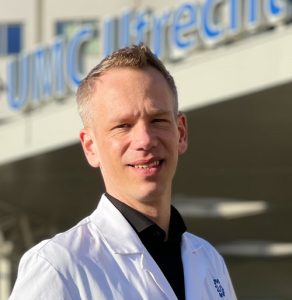
András Spaan
Although physicians have long been able to diagnose PG, determining its cause has proved difficult. The condition can likely arise through several distinct biological mechanisms. “We tend to assume that patients with the same clinical picture share the underlying disease process,” says clinical microbiologist András Spaan of UMC Utrecht. “But disruptions of different biological pathways can sometimes cause the very same clinical disease.”
The team therefore focused on patients with a particularly severe, early-onset form of the disease. “In extreme cases like these, one can often more easily identify a genetic cause and gain insight into the underlying molecular mechanisms,” Spaan explains.
The researchers found that a specific defect in a gene called OTULIN drives the disease in these patients. The defect throws key inflammatory processes out of balance: white blood cells overproduce inflammatory molecules, while skin cells become hypersensitive to inflammatory signals. Together, these effects produce the severe skin ulcers that define the condition.
The new insights also directly led to a potential treatment. The researchers used a TNF-inhibitor, a drug already used for various inflammatory diseases. “What makes this special is that we didn’t need to develop a new drug,” Spaan says. “We were able to use a therapy we know well. As a result, the first patients have already been successfully treated.”
Although the genetic basis of PG likely varies between patients, the researchers believe the discovery has broader relevance. ” For the first time, we have a clear understanding of the mechanism underlying the disease,” says Spaan. “That gives us a real foothold for investigating which other genetic causes can lead to the same disease.”
This work demonstrates the potential when clinical care and laboratory research are tightly linked. Patient histories provided the starting point; lab work translated those observations into a targeted therapy. “That is the strength of a university medical center,” Spaan says. “What we see at the bedside, we can study in the lab — and what we learn in the lab, we bring back to the patient.”
The approach reflects UMC Utrecht’s broader direction of integrating care, research and education, so that patients can benefit more quickly from new scientific insights.
This research was conducted in an international setting and was made possible in part through a longstanding collaboration between UMC Utrecht and researchers at Vanderbilt University Medical Center in the United States.
View the published research in Nature Immunology