Irena Muffels (WKZ, genetics) and researchers from the Icahn School of Medicine at Mount Sinai in New York have made an important discovery concerning an extremely rare inherited brain disorder. They have identified both the cause of the disorder and a potential treatment.
The condition is caused by a genetic abnormality and resembles Parkinson’s disease in some respects, but affects children. A form of vitamin B3 appears to slow the progression of the disease in patients. Irena Muffels, ANIOS in clinical genetics, explains how this discovery came about and what it could mean for children and their families.
“DHDDS is a very rare inherited condition that has been diagnosed in around eighty people worldwide. Children with this condition often suffer from movement difficulties, tremors, epileptic seizures and developmental delays. The condition is progressive. Until now, there was no treatment that could slow the disease’s progression. This was incredibly difficult for families, as they watched their child’s condition slowly deteriorate without us knowing exactly why it was happening.”
“When I was working in New York, the parents of children with DHDDS got in touch with us. Their children’s condition was deteriorating and they didn’t want to just sit back and wait. They asked if there was anything we could do. As we cannot take brain tissue from children for research purposes, we started looking for an alternative: organoids.”
Organoids are small pieces of brain tissue grown in the laboratory from human stem cells. They mimic certain characteristics of a real brain. This enables researchers to study diseases and test potential treatments.
“We used skin cells from patients and reprogrammed them back into a type of stem cell. We then allowed them to develop into mini-brains: small pieces of brain tissue that display the same characteristics as the patient’s brain.”
“With the mini-brains, we were able to track the disease step by step for the first time. After about four months, we saw that they began to show the same signs of deterioration as the patients. This enabled us to investigate exactly what goes wrong. We discovered that, due to the genetic abnormality, an important substance, dolichol, is not produced in sufficient quantities. This ultimately leads to a build-up of cholesterol in certain supporting brain cells, known as astrocytes. We believe that this build-up is a major cause of the progressive deterioration we see in patients.”
“We tested a large number of substances, medicines and vitamins in the mini-brains. One substance in particular stood out: nicotinamide mononucleotide, or NMN for short. This is a natural form of vitamin B3. In the laboratory, we observed that this substance could reduce the abnormalities in the brain cells. That was a promising result and prompted us to investigate further whether patients might also benefit from it.”
“The initial results were surprisingly positive. Within a month, we noticed improvements. Children were able to walk better, had more energy, trembled less and moved more smoothly. It’s important to remain cautious, as this involves a small group of patients and we still need to analyse the results thoroughly. But for families who have had no treatment options for years, these are, of course, very hopeful signs.”
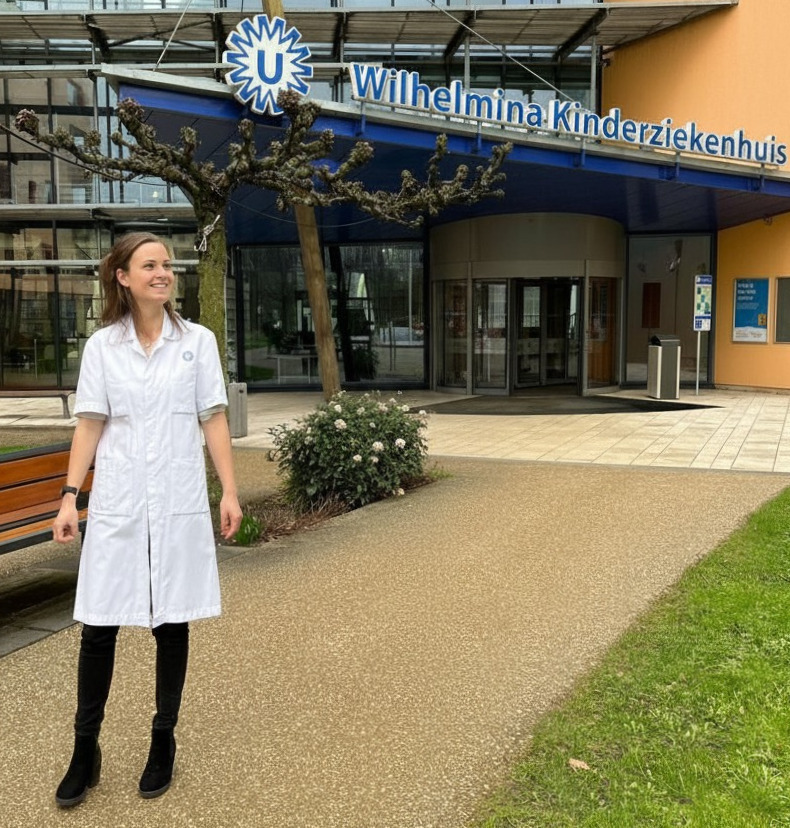
Irena at the WKZ
“With funding from the British patient organisation CDG UK, we are conducting a study at Mount Sinai to investigate the effects of NMN over a longer period. Our aim is to gain a better understanding of how effective the treatment is and which patients benefit most from it. Hopefully, we will also be able to include children with this condition in the study through the WKZ.”
“Furthermore, this research demonstrates just how powerful ‘mini-brains’ can be. This technique enables us to better understand rare diseases and potentially find new treatments more quickly. This offers hope not only for children with DHDDS, but also for many other patients with rare neurological conditions.”