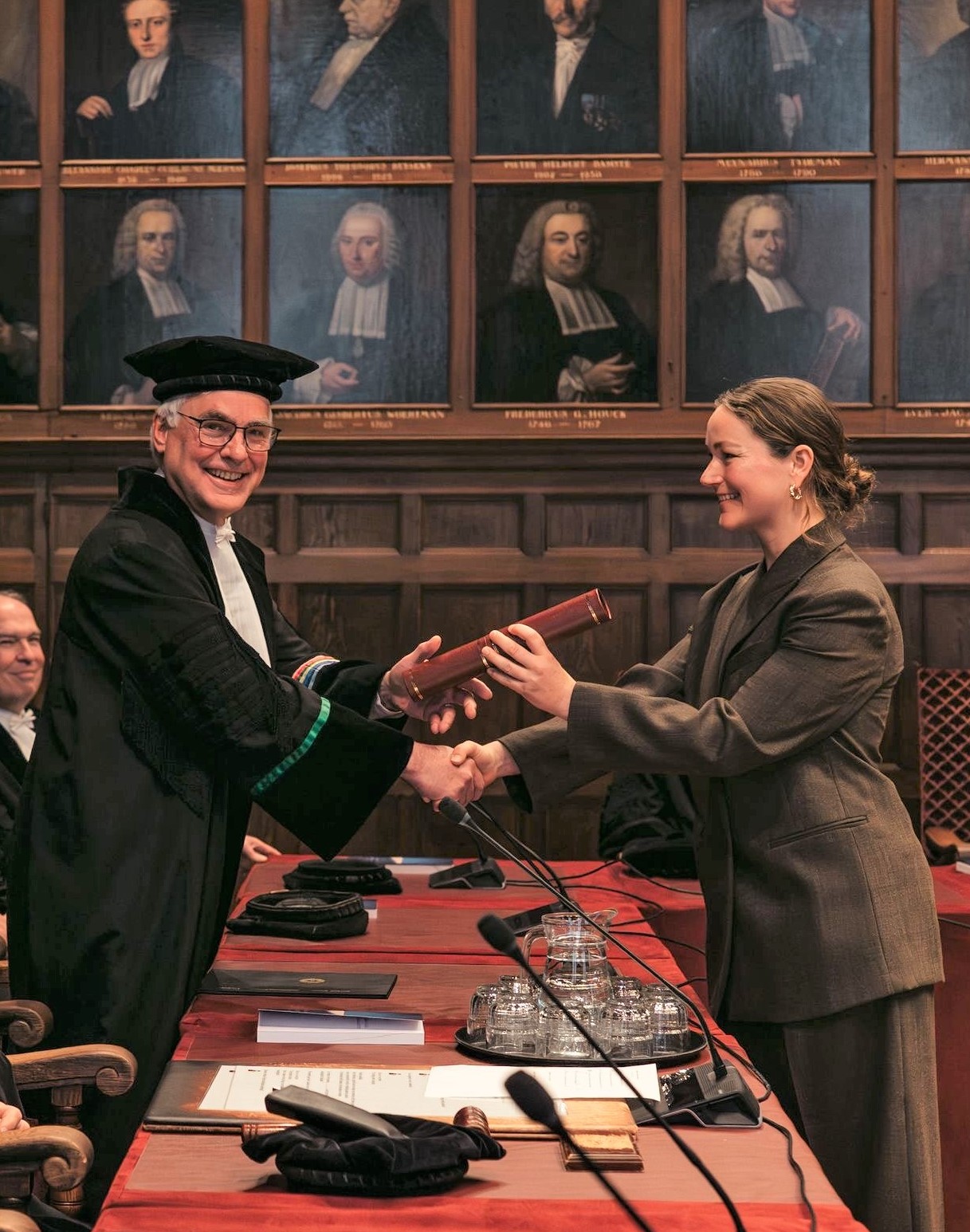
Research by PhD candidate Emma de Fraiture MD (UMC Utrecht and St. Antonius Hospital, Nieuwegein) has shown that fast bedside analysis of the immune system can help identify which trauma and surgical patients are most at risk of complications. The findings pave the way for a new form of ‘immune-protective surgery’, in which treatment decisions are tailored to the patient’s immune status to improve recovery and reduce complications.
Severe trauma, major surgery and fractures in frail older adults trigger a body-wide immune response. This reaction is essential for tissue repair and infection control, but when it becomes excessive or dysregulated it can contribute to infections, organ failure and delayed recovery. Surgery after trauma may act as a ‘second hit’, further amplifying this response.
The PhD research project of Emma de Fraiture MD (Departments of Trauma Surgery at UMC Utrecht and St. Antonius Hospital, Nieuwegein) focused on neutrophils, the white blood cells that form the body’s first line of defense after tissue damage. Emma and colleagues found that trauma and surgery rapidly alter both the activity and composition of these cells. In particular, the early appearance of a particular type of young immature neutrophils was strongly associated with an increased risk of infectious complications and adverse outcomes.
Beyond traditional injury scores
Importantly, this immune activation did not consistently correspond with the anatomical severity of injury. Emma de Fraiture explains: “Some patients with apparently limited tissue damage showed a pronounced immune response, while others with high injury scores did not. These findings demonstrate that traditional anatomy-based scores capture only part of the biological impact of trauma.”
“Some patients with apparently limited tissue damage showed a pronounced immune response, while others with high injury scores did not. These findings demonstrate that traditional anatomy-based scores capture only part of the biological impact of trauma.”
Results available within 20 minutes
A major technological advance behind the work of Emma was the use of fully automated bedside flow cytometry, which enables clinicians to assess neutrophil profiles within 20 minutes, directly in acute care settings. At UMC Utrecht, this technology has gradually been implemented in daily clinical care at the department of Trauma Surgery at UMC Utrecht. Analysis of the immune system can now be executed much faster, better and cheaper. Because the method requires minimal sample handling, it is suitable for emergency departments, intensive care units and operating rooms, including outside regular working hours.
Direct implications for patient care
For patients, this type of diagnostic immunoassays could lead to earlier and more personalized interventions. Immune profiling may help clinicians to decide whether surgery should proceed immediately or whether a staged damage control strategy would be safer for the patient. During hospital admission, early shifts in neutrophil patterns may also reveal a developing infection before onset of fever or when routine blood tests become abnormal, enabling earlier antibiotics administration and closer monitoring.
According to Emma, this approach is particularly promising for vulnerable older patients with hip fractures, where immune signatures may support treatment decisions and help guide conversations about risks and expected recovery.
Towards immune-protective surgery
Large-scale validation is now underway in an international study coordinated by UMC Utrecht, which aims to prospectively collect immunological data in 2.000 trauma patients in a multicenter setting. With help of the outcomes of this study, researchers intend to develop algorithms for automated data interpretation that allows to make immune monitoring an integral part of surgical decision-making. Ultimately, this should result a more personalized care that prevents complications, speeds up recovery and saves lives of trauma patients.
PhD defense
Emma de Fraiture MD (1997, Delft) defended her PhD thesis on April 16, 2026, at Utrecht University. The title of her thesis was “Exploring the possibilities of immune protective surgery in trauma and beyond.” Supervisor was Prof. Leo Koenderman, PhD (Department of Experimental Pulmonary Diseases and Center for Translational Immunology, UMC Utrecht) and co-supervisors were Falco Hietbrink, MD PhD (Department of Trauma Surgery, UMC Utrecht) and Detlef van der Velde, MD PhD (Department of Trauma Surgery, St. Antonius Hospital, Nieuwegein). In October 2025, Emma started as a surgical resident (not in training) at the St. Antonius Hospital in Nieuwegein.