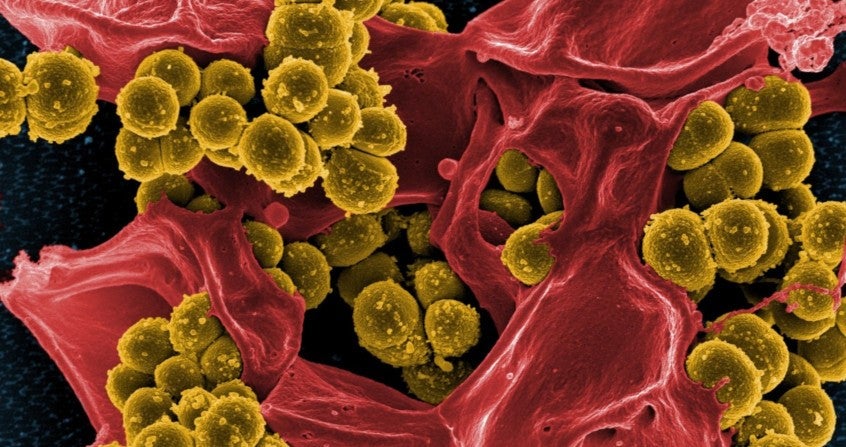
Implant-related infections caused by the Staphylococcus aureus are among the most difficult infections to treat. The bacteria can form a protective biofilm on artificial joints, heart valves and other medical implants, making them much less sensitive to antibiotics and the body’s immune system. Research by UMC Utrecht PhD candidate Zijian Ye shows that future treatment will likely require more than antibiotics alone. Instead, combining targeted therapies that attack bacteria in different ways may offer a more effective approach.
Staphylococcus aureus is a common bacterium that normally lives on the skin but can cause serious infections when it enters the body. In patients with medical implants, the bacteria can form a sticky biofilm that protects them from both antibiotics and immune cells. As antibiotic resistance continues to increase, these infections are becoming an even greater challenge for doctors. In his PhD research, Zijian Ye, MD (Department of Orthopedics, UMC Utrecht), investigated several new treatment strategies that target different weaknesses of biofilm infections.
Xijian Ye, MD PhD
One approach by Zijian Ye used radiolabelled antibodies to deliver radiation directly to the bacteria in an in vitro study. This targeted radioimmunotherapy was able to kill S. aureus growing freely as well as bacteria protected inside biofilms.
His research also identified ssDNA molecules, called aptamers, that block one of the bacterium’s key defense mechanisms. By preventing S. aureus from escaping the immune system, these aptamers helped immune cells recognize and remove the infection more effectively while also slowing early biofilm formation.
A third strategy explored by Zijian focused on gold nanocluster-loaded nanoparticles with bacterial killing activity directly into the biofilm. In laboratory studies and an animal model, this approach improved drug delivery, reduced the amount of biofilm and lowered the amount of S. aureus on infected implants.
Together, the findings showed that implant-associated biofilm infections should be treated by addressing several problems at the same time. Besides killing bacteria, future therapies should also improve drug delivery into the biofilm and help the immune system overcome the bacteria’s protective mechanisms.
“Biofilm infections are difficult to treat because bacteria are protected in several ways at the same time,” says Zijian Ye. “Our research shows that successful treatment requires a combination of targeted strategies that not only kill bacteria but also overcome the barriers created by the biofilm and strengthen the body’s natural immune response.”
The findings of this PhD project provide new directions for developing better therapies for patients with implant-associated infections, including infected artificial joints. Although these new treatment strategies still require further development before they can be used in patients, this project demonstrates that combining targeted radioimmunotherapy, immune-supporting molecules and advanced drug delivery systems could improve treatment of these persistent infections.
As antimicrobial resistance continues to rise worldwide, such innovative approaches may become increasingly important for preventing long-lasting infections and reducing the need for repeated surgery or removal of infected implants.
Zijian Ye, MD (1994, Dongguan, Guangdong, China) defended his PhD thesis on June 9, 2026 at Utrecht University. The title of his thesis was “Novel Therapeutic Strategies for Staphylococcus aureus Biofilm Infections.” Supervisors were Prof. Harrie Weinans, PhD and Prof. Bart van der Wal, MD PhD (both Department of Orthopedics, UMC Utrecht). Co-supervisors were Jaqueline Lourdes Rios, PhD (Department of Orthopedics, UMC Utrecht) and Alex Poot, PhD (Department of Pharmacy, UMC Utrecht).
Zijian Ye will continue his career as a surgical fellow at the Department of Orthopedics at Peking University Shenzhen Hospital in Shenzhen, China.