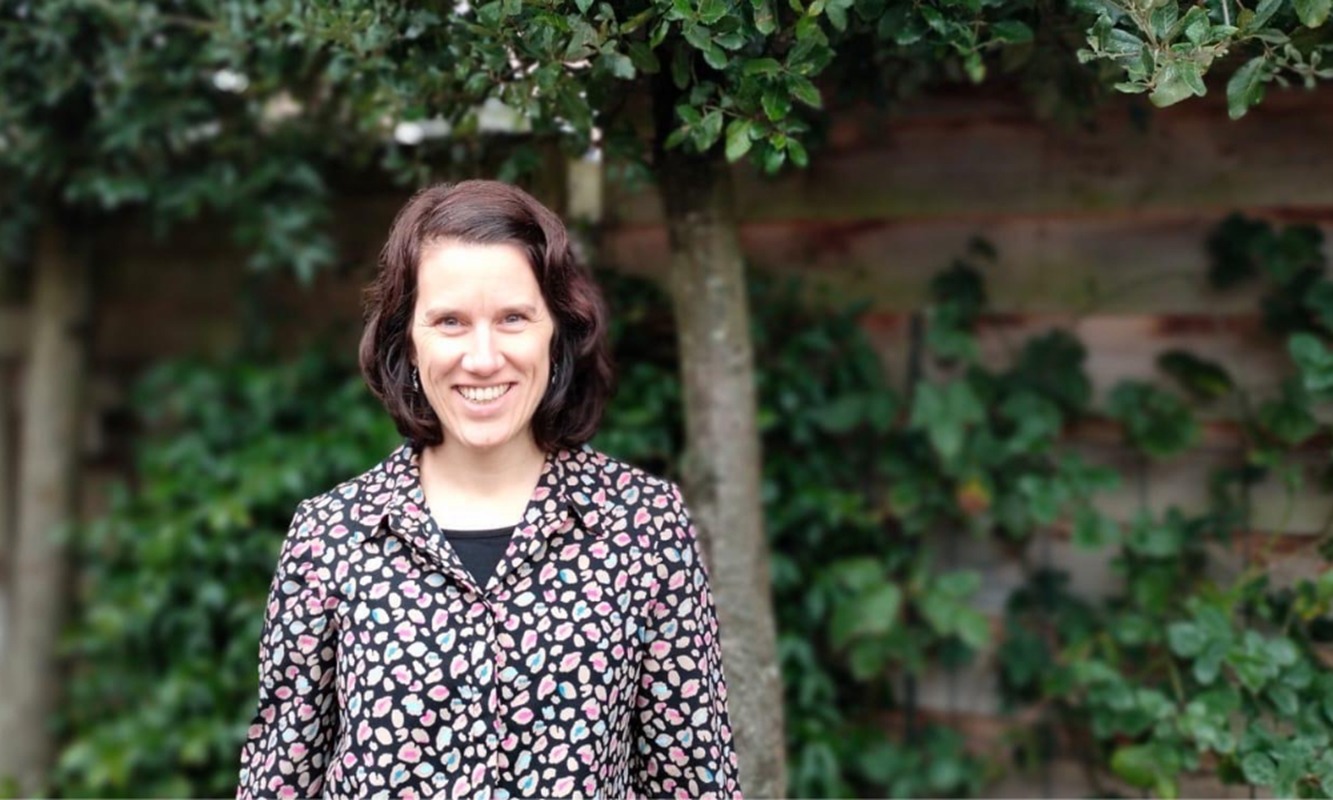
Breathing seems so natural. You simply inhale air into your lungs and then exhale it again. For people with the muscle disease SMA, however, breathing requires considerable effort. Kim Kant-Smits investigated whether the respiratory muscles of people with this muscle disease can be strengthened through training. She obtained her PhD from Utrecht University in December 2025.
People with spinal muscular atrophy (SMA) do not produce enough of a certain protein. This protein is necessary to maintain the strength of specific nerve cells in the spinal cord that send signals from the brain to the muscles, enabling movement. Without enough of this protein, the nerve cells that send these signals deteriorate, causing muscle weakness. Researcher and paediatric physiotherapist Kim Kant-Smits (41): “For about ten years now, there have been medicines that supplement the deficiency of this crucial protein as much as possible.”
One of the problems with SMA is that it can affect the respiratory muscles, making breathing difficult. Kant-Smits: ‘Inhaling is usually possible; these people are not extremely short of breath. But if your muscles are too weak to exhale, then coughing, for example, is difficult. And coughing is necessary to remove mucus from the airways. That mucus contains all kinds of bacteria. Not being able to cough can therefore lead to infections such as pneumonia.’ If such pneumonia takes a turn for the worse, the patient may end up in hospital or even die.
Kant-Smits investigated whether an approach could be devised to train the respiratory muscles of people with SMA, so that they can breathe out and cough more easily. As a paediatric physiotherapist, Kant-Smits has a lot of experience with exercises that make patients more self-reliant.
Thirty people with SMA participated in her doctoral research. She divided them into two groups of fifteen people. Kant-Smits had all thirty breathe in and out calmly through a so-called respiratory muscle trainer, a hollow device with a valve at the end. That valve can be opened, but there is a spring inside the device. It is similar to the spring in a ballpoint pen: such a pen has a spring at the end of the tip to open and close the ballpoint pen. The spring in a respiratory muscle trainer is similar. In this case, the spring operates the valve, which is opened and closed by breathing.
By breathing in and out, her test subjects had to “suck” or “blow” the flap in the breathing muscle trainer open. Kant-Smits: “The resistance of the spring on the flap is adjustable: you can loosen or tighten the spring. By adjusting it, the flap provides more or less resistance, making breathing easier or more difficult.”
During the first four months of the study, fifteen people were given a device with a “loose” spring, and fifteen were given one with a “tight” spring. Kant-Smits: “The aim of the study was to see whether the respiratory muscles can be trained. Usually, you need considerable resistance for this. The people who have to exhale against low resistance are the control group: they are given a less strenuous training programme.”
Her research question was whether the exercise works: do the respiratory muscles of people with SMA indeed become stronger, and do those of the group that trains with more resistance become more powerful than those of people with a looser spring? The big surprise of the study was that the respiratory muscles of both groups clearly became stronger thanks to the training: “The researchers expected a big difference between the group with high resistance and the control group, but that turned out not to be the case. The control group also improved!”
The thirty test subjects were trained for a year. After four months, they were allowed to continue building up their resistance themselves. “We saw a very clear relationship between the amount of training and the degree of improvement. Our conclusion across the board is that training helps these people, even a little bit makes a difference. But if you do more, you reap more benefits.”
“People with SMA who do respiratory muscle training can benefit greatly from it. Participants in the study reported that they could breathe more deeply, speak more loudly, form longer sentences, cough up mucus more easily and had more energy.” Kim Kant-Smits previously won the 2024 Spierfonds Impact Award for her contribution to helping people with SMA. And quite rightly so!
This year, radio station 3FM is taking action for Spieren voor Spieren to raise money for scientific research into neuromuscular muscle diseases such as SMA. Join in and visit 3FM Serious Request 2025.