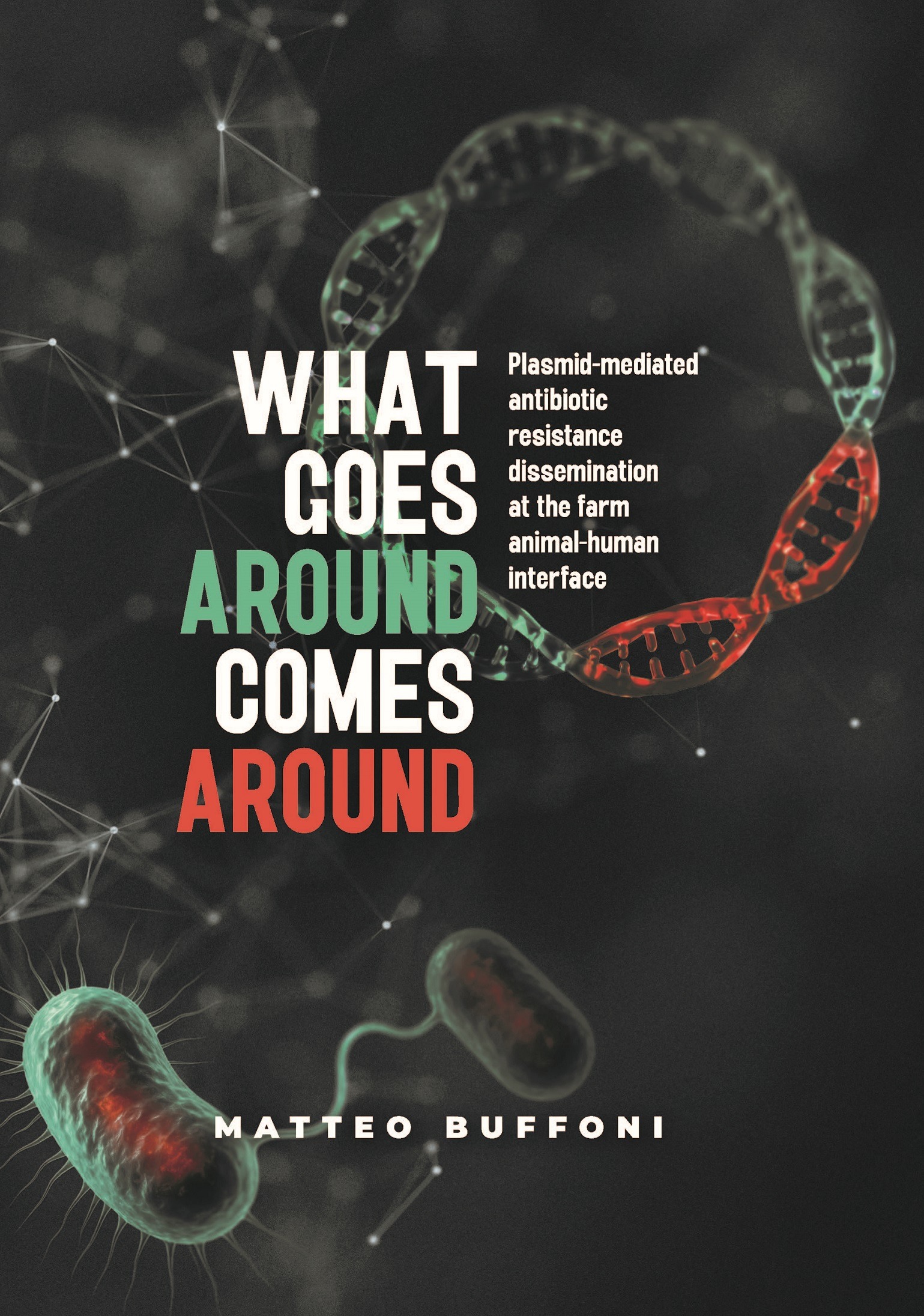
PhD work by Matteo Buffoni (UMC Utrecht and Wageningen University & Research) showed that mobile AMR genes can be selected by farming practices and that those genes can readily jump from farm animal bacteria to human bacteria thanks to plasmids. However, once in the human such bacteria face substantial biological barriers for long-term establishment. Understanding these complex ecological and molecular dynamics is vital for controlling AMR dissemination and safeguarding public health.
Antimicrobial resistance (AMR) is a growing public health challenge, impacting both humans and animals. Resistant bacteria, but also genes conferring AMR, can be transferred from animals to humans via direct contact, the food chain or the environment. Dissemination of resistance genes happens via a process called horizontal gene transfer. This process involves typical DNA molecules that can replicate independently from the host genome, called mobile genetic elements (MGEs). The most relevant MGE is the plasmid, a circular extrachromosomal DNA molecule that often carries AMR genes. This DNA molecule possesses the ability to jump from one bacterial cell to another causing spread of AMR. Through this jumping, AMR genes harbored on plasmids selected in the farm environment can move to humans.
The PhD thesis by Matteo Buffoni, MSc (Department of Medical Microbiology, UMC Utrecht and Laboratory of Genetics, Wageningen University & Research) explored how AMR spreads beyond the farm environment, linking human, animal, and environmental well-being in a One Health challenge.
Our intestines (and those of animals) host vast communities of bacteria naturally containing AMR genes. On farms, where antibiotics are sometimes used, these genes can become prevalent. Matteo Buffoni and colleagues found in two field trials that some farming practices, like use of certain feed additives, had only minimal impact on the gut microbiome composition in post-weaning pigs. In contrast, in a field study that explored two strategies (vaccination and coccidiostat drugs) to prevent parasitic infections in broiler chickens, the researchers found that there was an effect on the resistome (all resistance genes) and the presence of MGEs carrying AMR. These findings showed that chicken farms are possible reservoirs for transferable resistance genes and that farming practices influence the resistome composition.
The investigators then focused on one specific plasmid type (encoding for resistance against 3rd generation cephalosporins), which is common in chickens and human infections. They used it as a model to understand plasmid-mediated AMR dissemination from chickens to humans. They observed that these plasmids, harbored in chicken E. coli, transferred with the same efficacy to E. coli of both human and chicken sources. This indicates that the plasmid is very good at jumping from animal to human bacteria. However, a crucial finding was that it had significantly lower stability and a higher loss rate in human E. coli as compared to chicken E. coli. To be able to persist in new human hosts, the plasmid had to undergo rapid genetic adaptations, often shrinking, to reduce its burden on host cells. These adaptations seem beneficial as they may limit dissemination of resistance genes in humans.
In summary, the work in the PhD thesis of Matteo Buffoni showed that AMR genes, actively selected in the farm environment by farming practices, can readily jump from farm animal bacteria to human bacteria using plasmids. However, they have to face substantial biological barriers for long-term establishment in a novel host. Understanding these complex ecological and molecular dynamics is vital for controlling resistance dissemination and safeguarding public health within the One Health framework.
AMR occurs when bacteria, viruses, fungi and parasites change over time and no longer respond to medicines. This makes infections harder to treat and increases the risk of disease spread, severe illness and death. As a result of drug resistance, antibiotics and other antimicrobial medicines become less effective and infections become increasingly difficult or impossible to treat. A recent WHO estimate suggests that AMR is responsible for more than 1 million deaths globally per year, with six pathogens being responsible for the majority of cases: Escherichia coli, Staphylococcus aureus, Klebsiella pneumoniae, Streptococcus pneumoniae, Acinetobacter baumanii and Pseudomonas aeruginosa.
Matteo Buffoni, MSc (1991, Rome, Italy) defended his PhD thesis on January 5, 2026, at Utrecht University. The title of his thesis was “What goes around comes around – Plasmid-mediated antibiotic resistance dissemination at the farm animal-human interface.” Supervisors were Prof. em. Rob Willems, PhD (Department of Medical Microbiology, UMC Utrecht) and Prof. Arjan de Visser, PhD (Laboratory of Genetics, Wageningen University & Research). Co-supervisors were Anita Schürch, PhD and Fernanda Paganelli, PhD (both Department of Medical Microbiology, UMC Utrecht).