UMC Utrecht is the first in the Netherlands – and one of the first in the world – to perform a new treatment for patients who develop a persistent fistula to the airway after esophageal surgery for cancer. This innovative procedure offers a solution for patients who are not fit enough for major reconstructive surgery but suffer from serious complications such as pneumonia, breathing problems, and difficulty eating.
The treatment is intended for patients who underwent a gastric tube reconstruction after esophagectomy due to cancer. In some of these patients, poor healing of the junction between the esophagus and the stomach causes an unwanted connection between the airway and the new esophagus, a fistula. This often leads to chronic pneumonia with prolonged hospital stays. Until now, treatment options have been limited.
“Major reconstructive surgery is often no longer an option for these patients. They are too weak, and spontaneous healing almost never occurs. That’s why it was necessary to develop new treatment options.”
The surgery
During the procedure, fat tissue is first harvested via liposuction. This tissue is then processed immediately during the same procedure, isolating a specific cell population: the stromal vascular fraction (SVF). This fraction contains regenerative cells that help wound healing and recovery. The technique for quickly isolating these cells was developed by the plastic surgery department of the UMC Utrecht. The SVF is then mixed with platelet-rich plasma (PRP), derived from the patient’s own blood. “These platelets contain substances that enhance the healing process”, explains plastic surgeon Joris van Dongen.
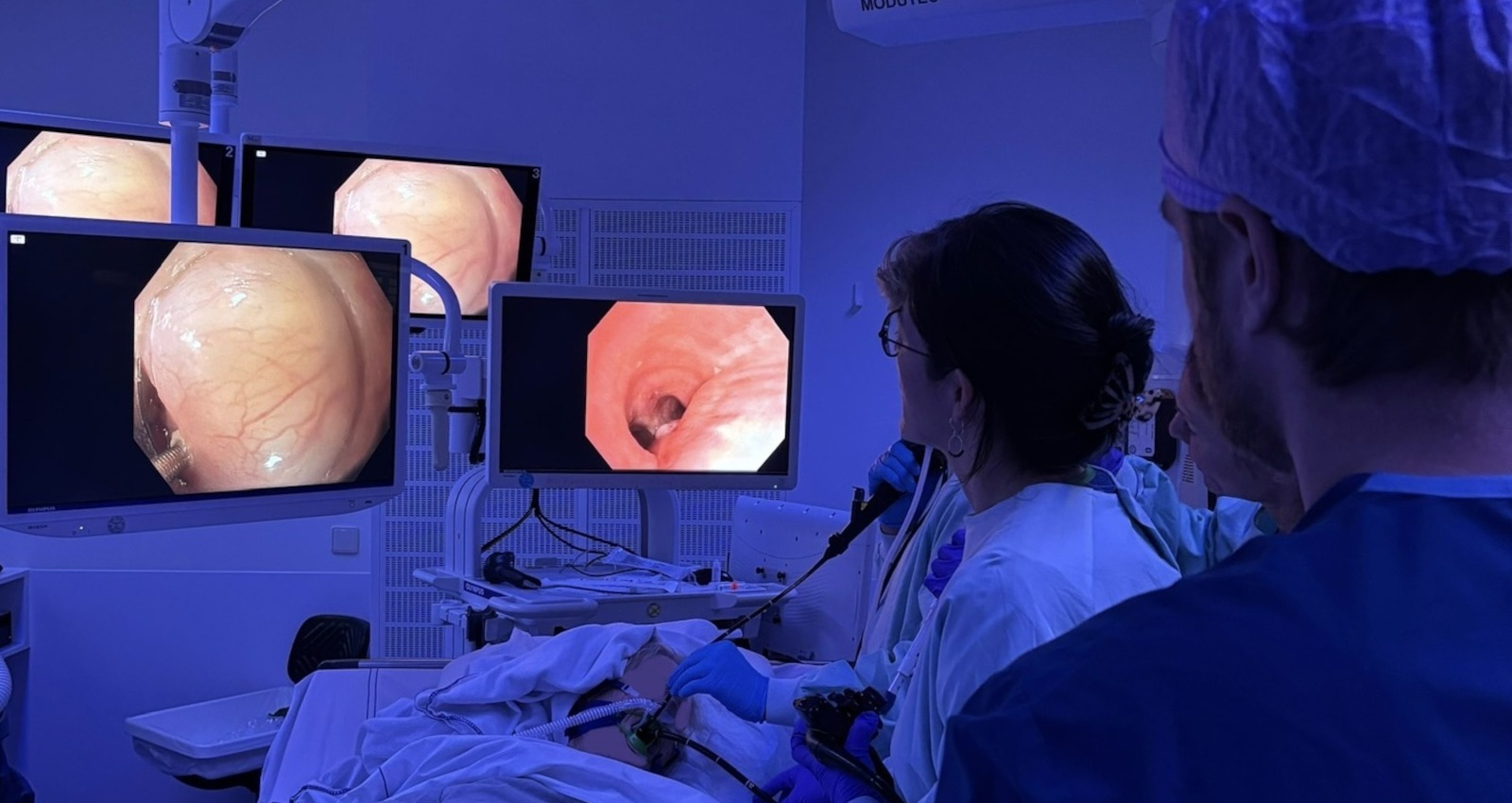
The gastroenterologist then locates the fistula using a scope and cleans it completely, creating a ‘new’ wound. The mixture of SVF and PRP is then injected into the fistula wall, after which the fistula is closed through the endoscope with endoscopic sutures secured with small tacks. “The beauty of it is that the treatment can be performed in a single procedure. No prolonged cell culture or external laboratory processing is required”, adds gastrointestinal surgeon Richard van Hillegersberg. “This makes the treatment immediately applicable and suitable for clinical practice.”
Multidisciplinary
The strength of this new approach lies in collaboration between different disciplines: gastroenterologists, plastic surgeons, gastrointestinal surgeons, and pulmonologists. Pouw explains: “In some patients, the pulmonologist assists the gastroenterologist from the airway side. In these cases, a double endoscopy is performed.” Van Dongen adds that this collaboration is essential: “By combining this expertise, we have created a completely new treatment pathway for a problem that previously had very few solutions.”
The initial results are promising in the first eight patients treated at UMC Utrecht. Patients recover much faster than before, with a significantly lower risk of complications. “One of the first patients who underwent the procedure was in intensive care and had little prospect of improvement. Three weeks later, he was discharged and can now resume all his daily activities with a very good quality of life,” says Pouw. “For these patients, this can mean the difference between hopelessness and a new perspective.”
UMC Utrecht expects that this cell therapy will also be applicable to fistulas with other causes in the future. “This is just the beginning”, says Van Hillegersberg. “We are opening an entirely new pathway in the treatment of complex fistulas.”
Scientific publication and procedural video
The procedure and the first clinical outcomes are also described in a recent scientific publication. This article includes a video that shows the treatment step by step, providing insight into how the combination of endoscopy and cell therapy is applied in clinical practice.
Collaboration within Oncomid and RAKU
This treatment was developed within Oncomid, the oncology network of the central Netherlands. Within Oncomid, hospitals and independent treatment centers work closely together in expert teams. The Esophagus | Stomach | Gastrointestinal Stromal Tumor (GIST) expert team was established through collaboration within the Regional Academic Cancer Center Utrecht (RAKU).
Within RAKU, UMC Utrecht, Meander Medical Center, St. Antonius Hospital, Diakonessenhuis, Ziekenhuis Rivierenland, Ziekenhuis Gelderse Vallei, and Beatrix Hospital (Rivas Healthcare Group) collaborate in the treatment of abdominal tumors. By bringing together the knowledge and experience of specialists from across the region into a single team, patients gain access to the latest insights and innovative treatments.