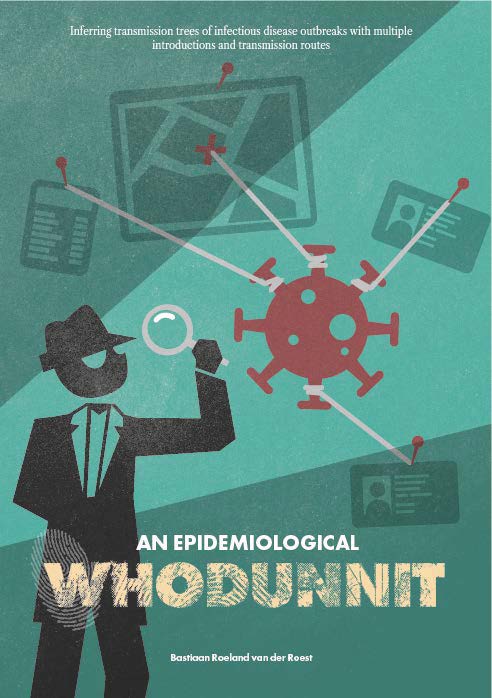
PhD research by Bastiaan van der Roest (UMC Utrecht) expands transmission tree inference by enhancing the phybreak model to account for multiple introductions and integrate contact data. These extensions improve the model’s applicability to real-life outbreaks, as demonstrated in case studies of SARS-CoV-2 and Mpox. By integrating contact types, the model strengthens inferences and allows for a deeper understanding of how important different contact events are for virus transmission.
Infectious disease outbreaks are like the complex puzzles often found in murder mysteries, trying to identify the right suspect. Infectious disease epidemiologists aim to solve the same type of puzzle, determining “who infected whom” during an outbreak. By studying transmission events, they gain valuable insights into the dynamics of outbreaks, using a forensic toolkit that includes two main tools: contact tracing and genetic sequencing. In outbreaks where nearly every case has been sampled, genetic sequencing plays a crucial role in identifying how the pathogen evolves within a population, helping scientists determine the chain of transmission. By combining this data with epidemiological details, researchers can track the path of the infection. However, the assumptions made in these methods often limit their applicability to real-world outbreaks.
Role of introductions and contact types
The PhD dissertation of Bastiaan van der Roest, MSc (Infectious Disease Modeling group, Research Program Infectious Diseases, UMC Utrecht) focused on modeling how infection transmission is traced. One area of exploration was the role of multiple introductions, where cases are infected from outside the population being studied. Another key focus is the role of contacts in disease transmission. Current transmission tree inference models often assume a single introduction and fail to account for varying types of contact, limiting their usefulness in real outbreak analysis.
“Underreported connections can obscure transmission routes, while reinfection complicates assignment of multiple introductions within a host. Furthermore, non-tree-like pathogen evolution, such as recombination or horizontal gene transfer, undermines the assumptions of most transmission models.”
Expanding the phybreak inference model
While outbreaks often involve multiple introductions, traditional methods typically assume a single index case, limiting their applicability. To address this limitation, Bastiaan’s work expands the ‘phybreak inference model’ to support the estimation of multiple introductions and integrate contact data, improving both the applicability and accuracy of outbreak reconstructions. This extended model, which introduces a ‘history host’ as a source population for index cases, enables the observed outbreak to be represented in a single phylogenetic tree. This approach successfully identified multiple introductions of SARS-CoV-2 on mink farms in the Netherlands and demonstrated that ongoing introductions were a driving force behind the 2022 Mpox outbreak in Slovenia. The method also showed promise for real-time outbreak analysis, with early-stage supported introductions matching those confirmed in retrospective analyses.
A further extension of the ‘phybreak model’ was to integrate contact data, such that the importance of different contact types to transmission could be estimated. For example, in the same SARS-CoV-2 outbreak on mink farms, sharing personnel was found to be risky for transmission as farms which shared personnel were consecutive cases in the chain of transmissions.
According to Bastiaan van der Roest, challenges remain, particularly regarding incomplete or biased reporting of contact data: “Underreported connections can obscure transmission routes, while reinfection complicates assignment of multiple introductions within a host. Furthermore, non-tree-like pathogen evolution, such as recombination or horizontal gene transfer, undermines the assumptions of most transmission models. To address these challenges, we need more flexible models and better integration of data sources, along with advancements in computational methods.”
While further methodological advancements are needed, this research shows that phybreak is now well-suited for outbreak analysis, providing valuable insights for designing effective public health measures.
Research funding
This project was funded by the Netherlands Centre for One Health (NCOH) via its Complex Systems & Metagenomics program, an overarching theme for more than 10 PhD tracks to create new interdisciplinary, inter-thematic, and inter-institutional research collaborations. NCOH aims for an integrated One Health approach to tackle the global risk of infectious diseases. NCOH commits to create durable solutions for this major challenge by bundling world-leading academic top research in the Netherlands in the area of One Health.
PhD defense
Bastiaan van der Roest, MSc (1993, Huizen NH) defended his PhD thesis on January 6, 2026 at Utrecht University. The title of his thesis was “Inferring transmission trees of infectious disease outbreaks with multiple introductions and transmission routes – An epidemiological whodunnit.” Supervisors were Prof. Mirjam Kretzschmar, PhD (Infectious Disease Modeling group, Research Program Infectious Diseases, UMC Utrecht) and Egil Fischer, PhD (Department of Population Health Sciences, Faculty of Veterinary Medicine, Utrecht University). Co-supervisors were Martin Bootsma, PhD (Infectious Disease Modeling group, Research Program Infectious Diseases, UMC Utrecht) and Don Klinkenberg, PhD (National Institute for Public Health and the Environment, Bilthoven).
Previous articles on this subject
February 24, 2022
How mathematical modelling contributes to control of infectious diseases
March 16, 2021
Effect of schools measures depends on other options for social distancing
November 21, 2020
Mass screening for corona will not allow for reopening of society
July 22, 2020
Self-imposed measures and governmental interventions may halt spread of COVID-19