
Spierfonds has awarded a grant of more than €1.4 million to the Tailored Lifestyle programme (Leefstijl op Maat). With this funding, the foundation is investing in a nationwide collaboration between UMC Utrecht, Amsterdam UMC, Radboudumc and three specialised rehabilitation centres. The aim is to further develop and embed lifestyle care within rehabilitation for people with a muscle disease. The Tailored Lifestyle programme closely aligns with UMC Utrecht’s clinical expertise in rehabilitation for muscle diseases, where lifestyle and patient autonomy play an important role.
Eating more healthily, sleeping better and engaging in physical activity in a way that fits one’s abilities is often easier said than done for people with a muscle disease. Tailored Lifestyle therefore deliberately adopts a disease-transcending approach. Themes such as physical activity, nutrition, fatigue and sleep are relevant to almost everyone with a muscle disease. By structurally and purposefully integrating these themes into rehabilitation consultations, space is created to develop knowledge and apply it directly in clinical practice.
The initiative for launching this programme came from people with a muscle disease themselves. Research by Spierfonds and the patient organisation Spierziekten Nederland made it clear that there is a need for more knowledge and support related to lifestyle. Together with patient representatives and researchers, the areas where the greatest gains could be achieved were explored. The conclusion: lifestyle care needs to be better organised and implemented within rehabilitation care.
There is now broad consensus that lifestyle is important in muscle diseases. The challenge lies in its practical application. People with a muscle disease want advice that fits their personal situation. Healthcare professionals want to provide this, but often lack concrete tools. As a result, lifestyle care is not yet a standard part of rehabilitation treatment. Lifestyle Tailored aims to bridge this gap.
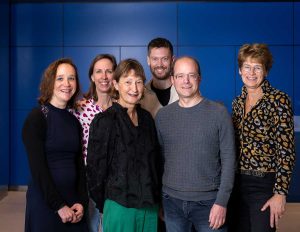
The Tailored Lifestyle consortium. From left to right: Dr Nicole Voet (Radboudumc), Dr Fieke Koopman (Amsterdam UMC), Prof. Dr Anne Visser-Meily (UMC Utrecht), Dr Eric Voorn (Amsterdam UMC), Prof. Dr Jan Groothuis (Radboudumc) and Dr Anita Beelen (UMC Utrecht).
Within a national consortium, Spierfonds collaborates with three university medical centres and three specialised rehabilitation centres. Together, these institutions treat a large proportion of people with a muscle disease in the Netherlands. Under the leadership of Amsterdam UMC, Radboudumc and UMC Utrecht, and in close collaboration with people with a muscle disease and their healthcare professionals, the consortium is developing integrated lifestyle care within rehabilitation treatment.
Professor of Rehabilitation Medicine Anne Visser-Meily (UMC Utrecht) emphasises the importance of this intensive collaboration between the UMCs: “I am proud that we are joining forces with Amsterdam UMC and Radboudumc. Rehabilitation departments are small on their own, but together we have much greater impact. By connecting knowledge, people and research, we are creating a collaboration that is truly integrated. That is impressive and exactly the direction UMCNL wants to move towards.”
For UMC Utrecht, the Tailored Lifestyle program fits seamlessly with the ambition to further innovate rehabilitation care for patients with a muscle disease. Senior researcher Anita Beelen, who will lead the programme from UMC Utrecht, sees particular value for patients: “What people can do themselves, they should indeed do themselves. This programme stimulates autonomy, self-management and preventive health. With innovations such as e-health, we can already support people before a hospital visit. What cannot be done independently is taken up by us or by primary care. In this way, we work together to build a healthy lifestyle that fits into daily life.”
A key component of the programme is clear explanation and education, Anita continues: “It may sound obvious, but many people are not fully aware of what physical activity or nutrition can mean for them. That is why we invest in clear explanations and (online) education. We want to help people take better care of themselves with information that matches their personal situation and physical capacity.”
Lifestyle interventions give people with a muscle disease greater control over their health. They provide insight, practical tools and strengthen patient autonomy. In the long term, they help prevent additional health problems and support both physical and mental fitness. This is not only valuable for daily functioning and participation in society, but also crucial for participation in clinical drug trials.
Dr Ellen Sterrenburg, Managing Director of Spierfonds, says: “Spierfonds initiated a collaboration between university medical centres, rehabilitation centres, healthcare professionals and people with a muscle disease. With Tailored Lifestyle, we are taking an important next step together: better support for people with a muscle disease in relation to lifestyle and making feasible choices that match their physical capacity and personal goals.”
The Muscle Disease Expertise Center at UMC Utrecht is a nationally recognized center for neuromuscular disorders. Our multidisciplinary team provides specialized care for patients with muscle diseases, trains specialists, and conducts research. We offer quick diagnostics, guidance, and treatment – often with a diagnosis and treatment recommendation within a single day. The Spieren voor Spieren Children’s Center at the Wilhelmina Children’s Hospital provides this care for children. Here, specialists work together for fast diagnostics, tailored treatment, and broad support for both the child and family. We aim to help children participate in daily life as much as possible.
