In June 2013, the UMC Utrecht Brain Center started tracking the number of PhD defenses within the center. Just over twelve and a half years later, a special milestone has been reached: the 500th PhD defense. We spoke with the 500th PhD graduate, Rianne de Jongh. Over the past few years, she conducted research on ALS in the lab of Jeroen Pasterkamp and developed a ‘neuromuscular junction-on-a-chip’ model to better understand where and how the disease begins. She will defend her thesis on Tuesday, February 24. “Cells are like people: you can’t just put them on pause, like a Tamagotchi.”
“I’m Rianne, 31 years old. I studied Biomedical Sciences at Utrecht University and then completed a Master’s in Neuroscience & Cognition, also in Utrecht. During my Master’s, I did an internship in Jeroen Pasterkamp’s lab. That’s where I discovered how much I enjoyed doing research myself: solving puzzles, designing experiments, discovering something new. I found all of that incredibly exciting. After a second internship in San Diego, I returned to Utrecht. Jeroen had offered me a PhD position after my internship, and that felt like a great opportunity.”
“When I heard that I would be number 500, I thought it was very special. Within your own lab or department, everything feels manageable: you know who is defending their thesis, and you know each other. But when you realize how many people have completed their PhDs within the entire Brain Center, you really get a sense of the scale of the research taking place here. At the same time, it’s also just a coincidence. I could just as easily have defended a few weeks earlier and not been number 500. Still, it’s a wonderful milestone. It shows how much knowledge comes together at UMC Utrecht and how many people contribute to brain research here.”
“ALS is a disease in which motor neurons—the nerve cells that control our muscles—degenerate and die. As a result, muscles lose their input, leading to muscle weakness and eventually paralysis. On average, people die three to five years after the first symptoms appear. It is a very devastating disease. With a view to early treatment, an important question in the field is: where does ALS begin? Does it start in the brain and spread to the muscles? Or does it begin at the nerve endings and the muscle?
To investigate this, I developed a human model of the connection between nerve and muscle, a so-called ‘NMJ-on-a-chip’. We reprogram patients’ skin cells into stem cells and then differentiate them into motor neurons and muscle cells. We bring these together in a special culture device, called a microfluidic chip, allowing us to study in the lab how nerve and muscle communicate with each other.”
“We found that in hereditary forms of ALS, something goes wrong in the axons—the part of the nerve cell that connects to the muscle. In these axons, the regulation of the production of important proteins is altered in people with ALS. As a result, higher levels of a particular protein are present, which means signals are transmitted less effectively to the muscle.
We also discovered that the muscle cells themselves are not always healthy. When we combined diseased muscle cells with healthy motor neurons, fewer and less functional connections were formed. These findings support the idea that ALS does not only start in the brain; problems may also begin at the connection between nerve and muscle—or perhaps as a combination of both.”
“I really enjoyed it, but it was also intense. Experiments fail; cells get contaminated, and sometimes you have to return to the lab on weekends. Cells are like people: they need nutrients and attention. You can’t just put them on pause, like a Tamagotchi. So, you have to stay motivated, deal with setbacks, and celebrate small successes. When an experiment finally works, it gives you a lot of energy.
Fortunately, I also had wonderful colleagues. We started around the same time and are defending our theses around the same time as well. You share both the highlights and the frustrations, which makes the journey special.”
“The Tour du ALS was very impressive. Climbing Mont Ventoux together with colleagues and patients. When you work in the lab, you normally don’t see patients. A day like that has a big impact. You talk to people who have ALS themselves or who have lost loved ones to the disease. That gives you extra motivation. Later, when you’re back in the lab and things get tough, you remember why you’re doing it.
Another highlight was a conference trip to Scotland. Before the conference, five colleagues and I went on a small road trip through Scotland in my camper van. At a campsite in the middle of nowhere, the engine broke down. Fortunately, there happened to be a mechanic staying at the campsite who was able to fix the problem. Experiences like that turn colleagues into friends.”
“That was very unexpected. Initially, Elly Hol was supposed to present at the event, but she fell ill at the last minute. Jeroen called me and asked, ‘What are you doing tomorrow evening? Would you be willing to present something about brain research in Tivoli?’ I said yes, because it’s a wonderful event.
I really enjoyed it. I think science communication is important, and it was a great challenge to explain my work to an audience that doesn’t know what we do in the lab. What kind of research are we doing? Why is it important? And how far have we come? I think many people have no idea what we are capable of in the lab today. That’s exactly what I like to show.”
Rianne de Jongh at the New Scientist Live! event 2024 in TivoliVredenburg Utrecht (in Dutch).
“It starts with a ten-minute lay presentation. In that talk, I explained my research to a broad audience, mainly friends and family. Then follows the 45-minute defense. The committee asks questions, and the idea is to show that you can think critically and engage in scientific discussion. It doesn’t have to be perfect. What matters most is showing that you can reflect: what would I do differently today, with the knowledge I now have?
After 45 minutes, the door opens. The beadle enters, wearing a gown and carrying a staff, and says: ‘hora est!’ That’s Latin for ‘it is time’. With that, the defense is over. The committee withdraws for deliberation. After that comes, hopefully, the awarding of the doctoral degree and the laudatio from my supervisor: a personal speech reflecting on my research and my development as a scientist.”
“I have started as a postdoctoral researcher in the lab of Eva Hedlund at Stockholm University and the Karolinska Institutet. I wanted to continue working in ALS research and further develop stem cell models of the neuromuscular junction. This lab also works on that topic, and I already knew it from conferences, so this new position fits well with what I built during my PhD.
In Sweden, I am supervising students again and working on new research proposals to obtain my own funding. In the coming years, I hope to further develop my own research line and deepen my understanding of the role of the neuromuscular junction in ALS.”
“That’s certainly possible. If I stay in ALS research- and I think I will – Utrecht would be a logical place to return to. The ALS Center here is very strong, and collaboration is well organized. At the same time, I want to keep all the doors open. For now, I’m mainly grateful that I can continue building on what I learned during my PhD.”
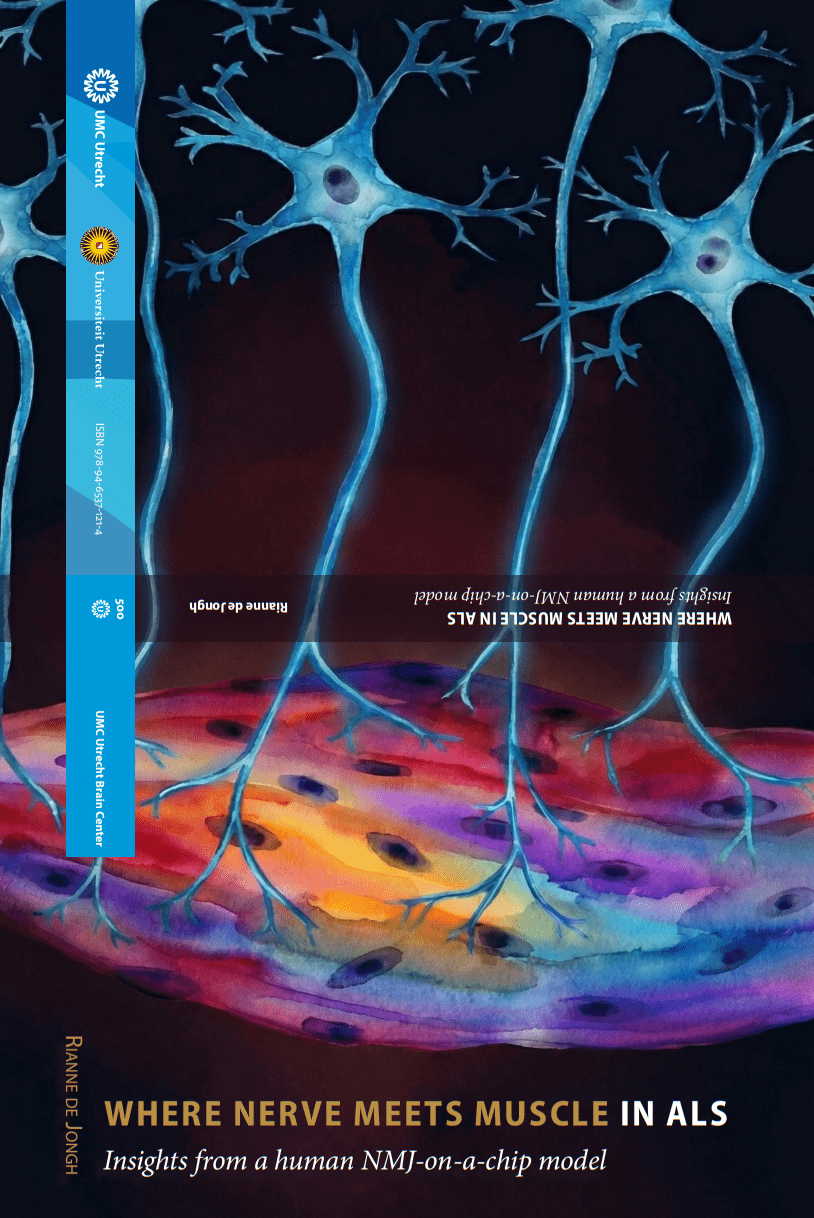
The cover of Rianne de Jongh’s thesis, entitled ‘Where nerve meets muscle in ALS’, bearing the number 500.