Patients with systemic lupus erythematosus (SLE) often wait months or years for a diagnosis, potentially allowing irreversible organ damage. Research by UMC Utrecht PhD candidate Tammo Brunekreef shows that analyzing patterns of autoantibodies, rather than individual markers, could help identify patients earlier. His findings also offer opportunities to improve clinical follow-up, accelerate research and move towards personalized treatment.
The rare autoimmune disease systemic lupus erythematosus (SLE) affects the skin, joints, kidneys and other organs. With a worldwide prevalence of approximately 44 per 100,000 people, SLE predominantly affects women (90 percent), mostly between ages 20 and 50. Its diverse symptoms make diagnosis and prediction of disease progression challenging. Tammo Brunekreef, MD (Department of Rheumatology and Clinical Immunology, UMC Utrecht) investigated how immune profiles and electronic health data could improve diagnosis and classification of SLE.
Brunekreef and colleagues analyzed 57 autoantibodies in 1,880 blood samples from patients with SLE, other inflammatory diseases, undiagnosed individuals and healthy donors. Their best-performing prediction model identified nine of 17 patients (53 percent) who subsequently developed SLE, before their clinical diagnosis, with 94 percent specificity. Antibodies targeting CpG DNA motifs emerged as promising markers, occurring in approximately 40 percent of SLE patients.
These findings suggest that immune profiles could enable earlier diagnosis, although larger validation studies are needed before clinical implementation.
The research also challenges how clinicians interpret positive antinuclear antibody (ANA) tests. Among 1,030 patients investigated, only 16 developed a new connective tissue disease diagnosis during follow-up. In symptomatic, undiagnosed patients, a positive ANA test had a predictive value of just 7 percent. More selective follow-up based on symptoms and disease-specific antibodies could reduce unnecessary appointments, patient uncertainty and healthcare costs.
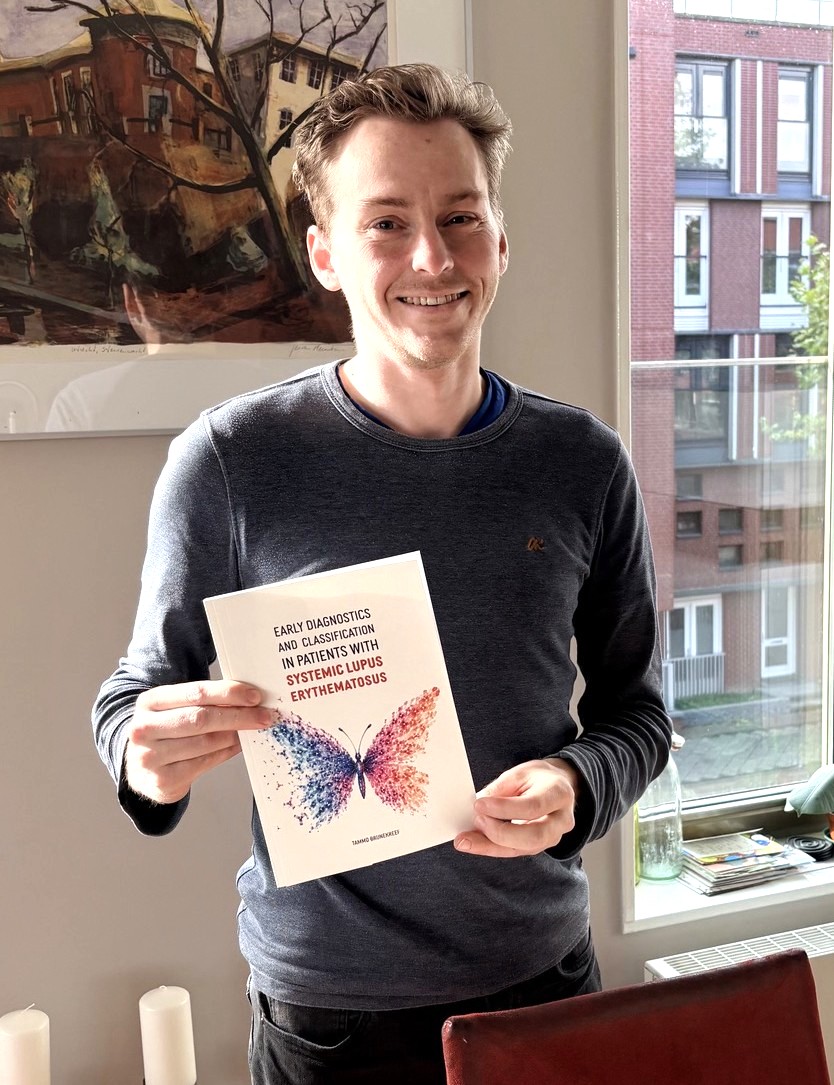
Tammo Brunekreef showing his PhD thesis
Brunekreef also developed a text-mining algorithm to extract diagnoses and symptoms from electronic health records. Compared with specialist assessment, the algorithm identified SLE with 96.4 percent sensitivity and 93.3 percent specificity. Such tools could reduce manual data collection and facilitate larger real-world studies, particularly for rare diseases with limited research populations.
Exploratory analyses also revealed associations between antibody profiles and the type I interferon pathway, an important driver of inflammation in SLE. Brunekreef explains: “These findings support a longer-term ambition: classifying patients according to their underlying immune mechanisms rather than on the basis of symptoms alone. This could eventually help clinicians select targeted treatments more effectively, although further validation and clinical trials are essential.”
Together, these advances point towards earlier diagnosis, more targeted treatment and more efficient healthcare, potentially reducing the burden of lupus for patients and society.
Tammo Brunekreef, PhD (1993, Utrecht) defended his PhD thesis on November 3, 2026 at Utrecht University. The thesis was titled “Early diagnostics and classification in patients with systemic lupus erythematosus.” Supervisor was Prof. Jaap van Laar, MD PhD (Department of Rheumatology and Clinical Immunology, UMC Utrecht). Co-supervisors were Henny Otten, PhD (Center for Translational Immunology, UMC Utrecht) and Maarten Limper, MD PhD (Department of Rheumatology and Clinical Immunology, UMC Utrecht). In 2025, Tammo started his training to become a specialist of internal medicine at Treant Hospital in Emmen.