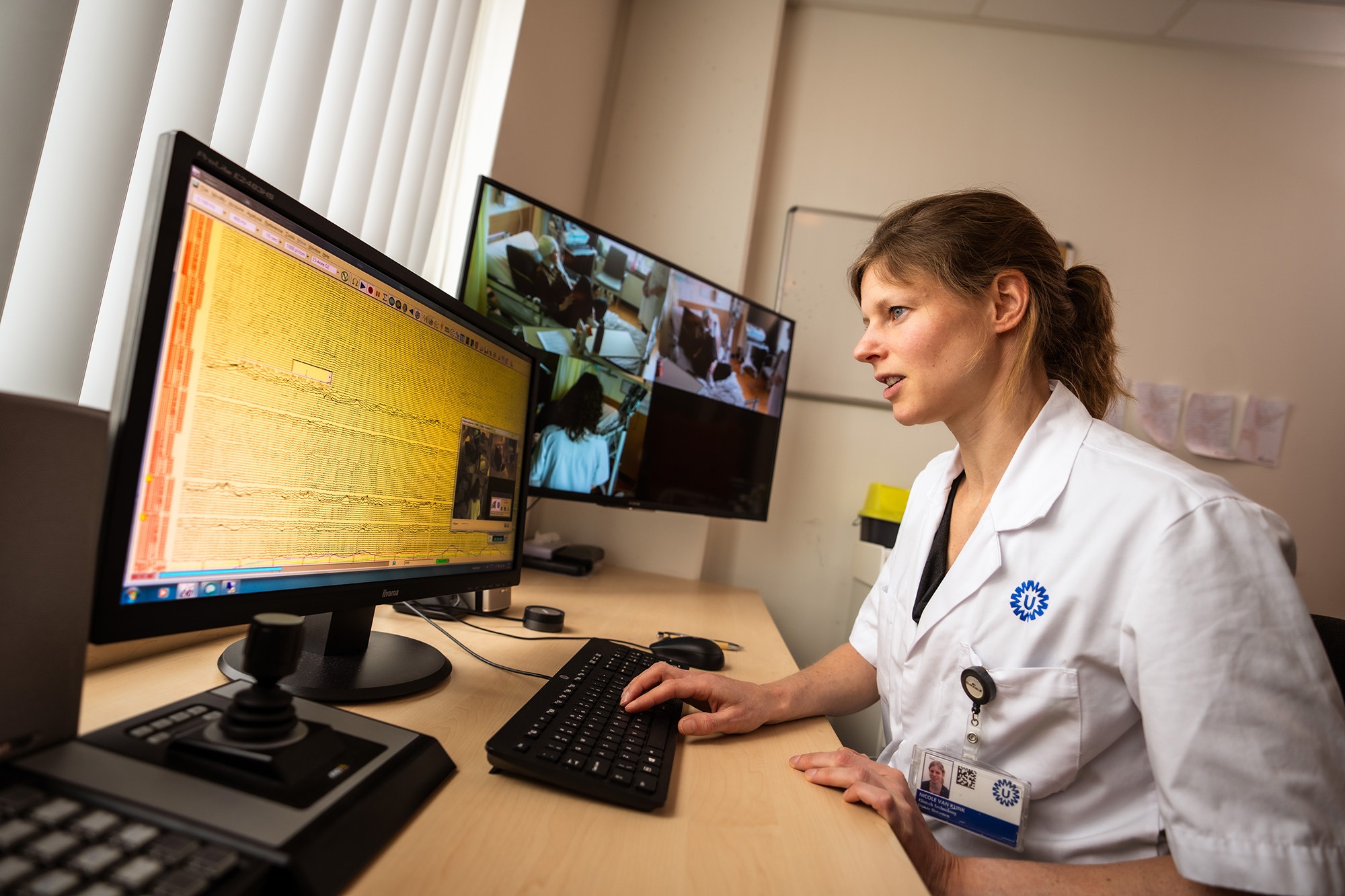
How can brain tissue that causes epileptic seizures be identified and removed even more precisely? Under the leadership of neurologist Prof. Dr Maeike Zijlmans, and in collaboration with neurosurgeon Dr Tristan van Doormaal, UMC Utrecht is developing a new technology that uses augmented reality (AR) to visualise measured epileptic brain signals directly during surgery. The team received a prestigious ERC Proof of Concept grant from the European Research Council (ERC) for this project.
Worldwide, more than 30 million people live with focal epilepsy, a form of epilepsy in which seizures originate in a specific area of the brain. Epilepsy surgery is often the only option to permanently relieve patients with drug-resistant focal epilepsy from their seizures. During such procedures, neurophysiologists and neurosurgeons use intraoperative electrocorticography (ioECoG), a technique that measures brain surface signals using an electrode grid placed directly on the cortex.
Until now, interpreting and sharing these signals – and especially identifying their exact location – has been complex and largely manual, increasing the risk of inaccuracies. The EpiShow project aims to change this. By using AR headsets such as the HoloLens, brain signals will be visualised in real time directly on the patient’s brain, integrated with MRI images. Surgeons can immediately see where epileptic activity occurs, even if electrodes shift during the procedure. “It is like placing a digital map over the brain that shows you live where you need to be,” says Zijlmans.
The project is a collaboration between UMC Utrecht and Augmedit, a medtech start-up specialising in augmented reality for brain surgery. Other partners include Neurosoft Bioelectronics, developer of flexible electrodes, and product design studio Productzaken. SURF, the IT infrastructure partner for education and research in the Netherlands, advises on secure data integration and streaming.
This technology shortens and accelerates the translation from scientific research to clinical practice. For researchers, it enables more accurate data collection. For surgeons, it supports faster and better-informed decision-making. For patients, it may make the difference between continuing to live with seizures or becoming completely seizure-free. Especially for children, where early treatment is crucial for development, the potential impact is significant.
With the ERC grant of €150,000, the research team is developing an initial proof of concept. The system will first be tested in a controlled environment to assess precision and usability. This will be followed by a pilot during an actual surgical procedure, without affecting patient care. The project runs until the end of 2027. During this period, the team will also explore pathways for market introduction, either as a standalone product or as part of a broader solution for epilepsy surgery.
The European Research Council (ERC) is Europe’s leading funding organisation for pioneering scientific research. Through its Proof of Concept funding scheme, the ERC helps researchers bridge the gap between breakthrough research and the early stages of commercialisation. These projects have the potential to drive meaningful change in healthcare and science.