At UMC Utrecht and Amsterdam UMC, brain surgeries have been performed for the first time with the support of a hologram. The technology was developed by the team of neurosurgeon Tristan van Doormaal at UMC Utrecht and the spin-off startup Augmedit that emerged from this team.
Two weeks ago, the first surgery using the new hologram technology took place at Amsterdam UMC. The patient had a life-threatening accumulation of cerebrospinal fluid in the brain’s ventricles. In such cases, the excess fluid is drained using a catheter—a thin tube that must be placed with extreme precision. Even so, this procedure does not succeed on the first attempt in around 30 percent of cases. One week later, the technology was also applied at UMC Utrecht in a second patient. This procedure was also successful.
Together with his research team and the startup Augmedit, which originated at UMC Utrecht, Tristan van Doormaal developed a method that uses artificial intelligence to rapidly convert standard two-dimensional MRI or CT images into an interactive hologram of the brain.
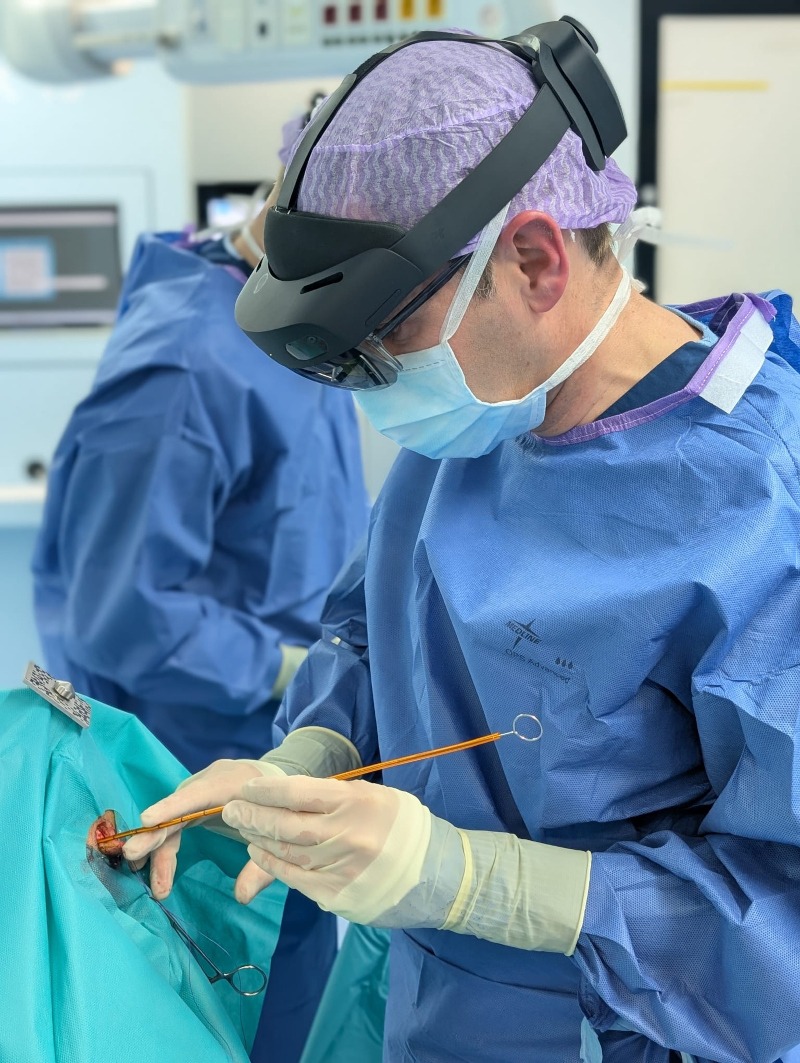
Neurosurgeon Tristan van Doornmaal in the OR using a VR headset.
This hologram is projected onto the patient’s head using special 3D glasses, allowing the surgeon to see the exact location of structures such as the brain ventricles in real time during surgery. Tristan explains: “This represents a fundamental change in how we prepare for and perform brain surgery. We bring 3D imaging directly to the patient’s head, at the moment it really matters.”
The technology has now received CE certification, meaning it has been officially approved for use in patients in Europe and meets European requirements for safety and effectiveness. Two weeks ago, the technology was used for the first time at Amsterdam UMC. This choice was deliberate: to ensure objectivity, the very first operation was performed by an independent colleague, neurosurgeon Maarten Bot. One week later, the second successful procedure took place at UMC Utrecht, led by Tristan himself.
“This major step forward is a wonderful example of valorisation: research developed at a Dutch university medical center that is now truly finding its way into global clinical practice,” says Tristan. “I am proud that this technology is being used to optimize patient care. That is exactly why we do this.”