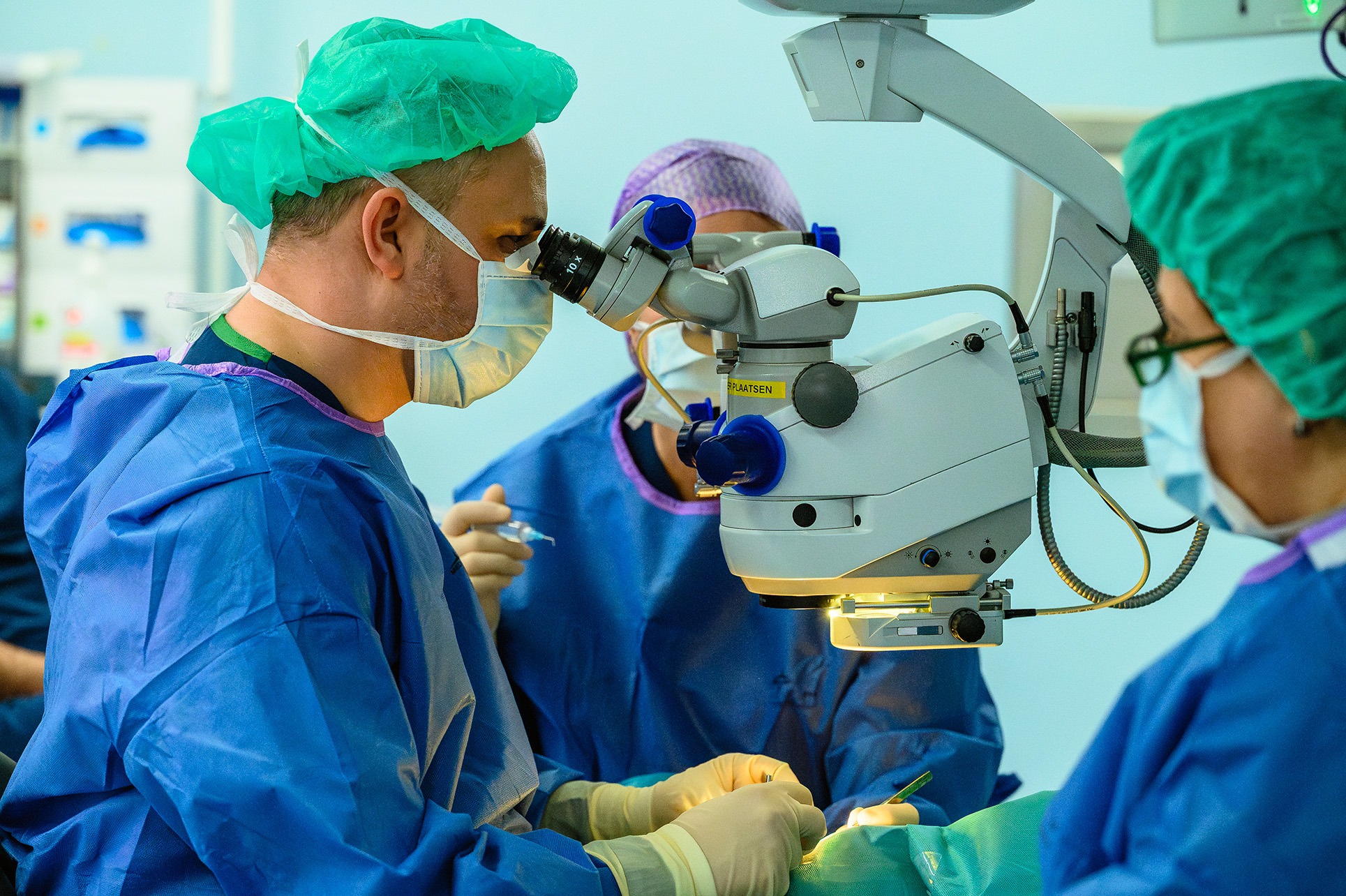
Using stem cells to repair the cornea. One remarkable eye surgery was performed last week by ophthalmologist Mor Dickman and his team at UMC Utrecht. The patient had severe damage to the cornea and received a unique treatment with stem cells. This can restore the eye surface and improve vision.
“Corneal damage has an enormous impact on patient daily life,” says Mor Dickman, who performed the surgery and serves as both professor and medical department head at UMC Utrecht. “With this surgery, we’re trying to restart the eye’s natural healing process.”
The cornea is the transparent layer at the front of the eye. It protects the eye and allows light to pass through so we can see properly. At the edge of the cornea are special stem cells. These limbal stem cells ensure that the ocular surface constantly renews itself.
When these stem cells become damaged, for example by a burn, infection, or accident, the cornea can no longer repair itself. “This can lead to pain, inflammation, and poor vision,” Mor explains. “Wounds no longer heal properly and scars develop.”
What is it called? Holoclar
What is it? A regenerative treatment in which a very small piece of tissue containing limbal stem cells is taken from the patient’s own eye, multiplied, and transplanted back.
For whom? For people with severe corneal damage who have lost limbal stem cells (for example, due to burns, infection, or accident), and have healthy limbal stem cells in the other eye.
Why? To restart the natural healing of the ocular surface and improve vision.
Advantage? The cornea can repair itself because the stem cells continue to produce new cells. Vision can improve and pain and inflammation can decrease. A future corneal transplant also becomes possible.
Patient Sandra received a stem cell transplant with Holoclar. This is a regenerative treatment in which stem cells from the patient’s own eye are cultivated and transplanted back. Until now, the treatment was only performed in the Netherlands at Maastricht UMC+. Last week, it happened for the first time in Utrecht as well.
Sandra’s cornea was severely damaged by fire, causing her to lose limbal stem cells. A small piece of healthy tissue was taken from her eye and sent to Italy. There, specialists cultivated the stem cells into a transplant on a natural carrier material, which keeps the cells in place.
Back in the Netherlands, Mor removed the scar tissue from the damaged eye and placed the transplant. “The cells then replace the damaged ocular surface,” says Mor. “A reserve of limbal stem cells also remains. These stem cells then produce new cells, so the cornea continues to heal.”
The surgery went well for Sandra. “Full recovery takes time, but it looks positive,” says Mor. “In a while, we’ll know how much vision has returned.” Sandra is also happy with the surgery: “I’m very grateful. Because this is now also possible in Utrecht, I was able to have this surgery.”
“It’s unique that we can perform this here,” says Mor. “The treatment is still relatively unknown. Doctors often think that when there’s damage to the limbus in the cornea, there’s no solution anymore. But there can be. Such stem cell treatment can enormously improve quality of life.”
Mor emphasizes the importance of awareness of this option for patients with corneal damage due to chemical burns, infection or trauma, and note that such cases can be evaluated at UMC Utrecht.
The surgery was only possible thanks to a large team including operating room staff, the pharmacy, and colleagues from Italy. “You can never do this alone,” says Mor. “Everything has to be exactly right. From planning to training. That makes it complex, but also very special.”
The patient’s name in this article has been changed.