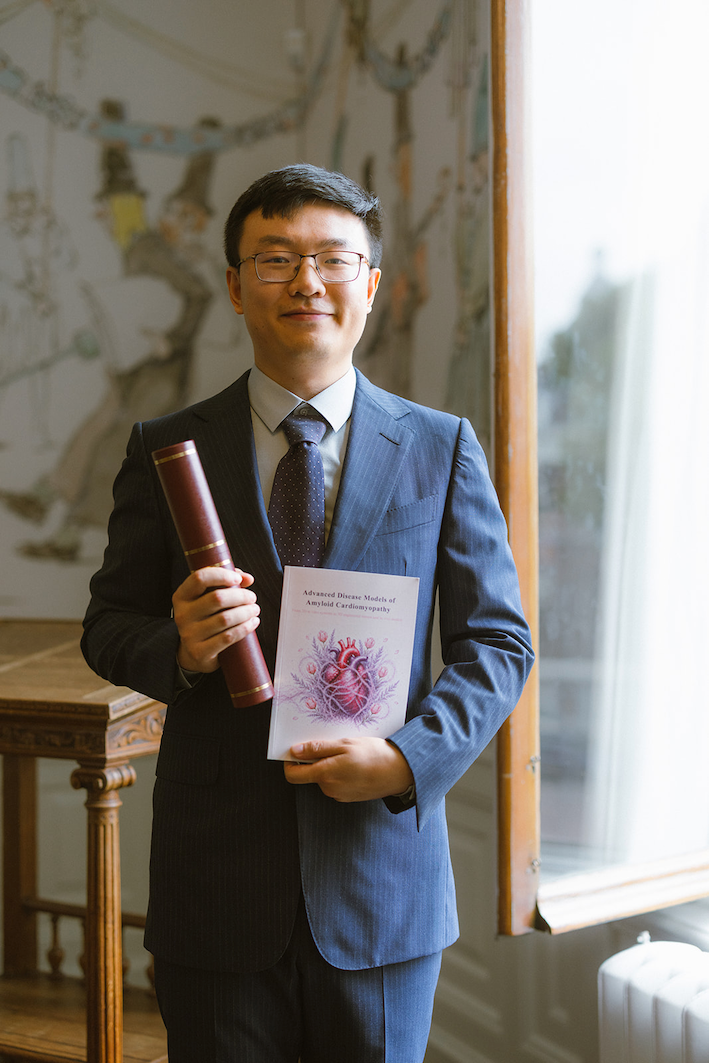
Cardiac amyloidosis is a serious heart disease that is often diagnosed too late because its symptoms overlap with those of other cardiovascular diseases. Using laboratory models that closely resemble the disease in humans, PhD researcher Jiabin Qin at UMC Utrecht uncovered how toxic proteins damage the heart. His findings could help pave the way for a less invasive diagnosis and may also reveal new treatment options. Qin defended his PhD thesis on July 8.
Amyloid cardiomyopathy is a serious cardiovascular disease caused by amyloid fibrils; clumps of misfolded proteins that accumulate in the heart and stiffen the heart muscle. As a result, the heart gradually becomes less efficient at pumping blood. Patients may develop symptoms such as shortness of breath, fatigue, arrhythmias, and heart failure.
“This disease is far more common than we realize, particularly in aging populations,” Qin explains. “As patients develop symptoms that overlap with other heart diseases, the disease is frequently missed, diagnosed far too late, or mistaken for another condition.” Furthermore, proper diagnosis often relies on a biopsy, an invasive procedure in which physicians remove a small sample of heart tissue.
And even when diagnosed correctly, existing therapies only slow disease progression and cannot restore heart function. “This is because we still don’t fully understand how amyloid proteins damage the heart,” Qin says. “To enable early diagnosis and develop better treatments, we first need to understand the disease’s underlying mechanisms.”
Supervised by Dr. Alain van Mil and Dr. Marish Oerlemans in close collaboration with the Dutch Patient Organization for Amyloidosis, Qin developed a range of advanced models that mimic how the disease develops in the human heart. These include heart cells grown in the lab from human stem cells, as well as small three-dimensional pieces of heart tissue.
With these models, Qin discovered that amyloid fibrils affect different heart cells in different ways. “The heart consists of several cell types, each with its own function,” he explains. “Rather than damaging every cell in the same way, amyloid fibrils affect each cell type differently.”
He also found that proteins outside the cells may play an important role in driving disease progression. This suggests that amyloid fibrils tell only part of the story.
The laboratory models proved to be highly reproducible, making them a reliable way to further research into amyloid cardiomyopathy. “We now want to understand how the disease works at the molecular level,” Qin explains. “With that knowledge, we hope to identify biomarkers; measurable molecules in the body that can help detect this disease.”
The researchers therefore want to study the proteins that heart cells release after toxic amyloid fibrils damage them. “Detecting the fibrils themselves still requires a biopsy of the heart tissue,” Qin says. “If we can find the proteins that the affected cells release in the blood, we can diagnose patients faster and without the need for an invasive cardiac biopsy.”
The disease models could also help reveal new targets for treatment and provide a way to test existing drugs. This could identify the therapies most likely to benefit patients.
Qin, now a postdoctoral researcher at Amsterdam UMC, looks back on his PhD above all as a lesson in persistence. “Failure is very normal part of research,” he says. “But most results are neither good nor bad: they just tell you something about how things work. After my PhD, I am not afraid of anything I still have to learn.”
This research received funding from Pfizer, Alnylam Pharmaceuticals, and Johnson & Johnson.