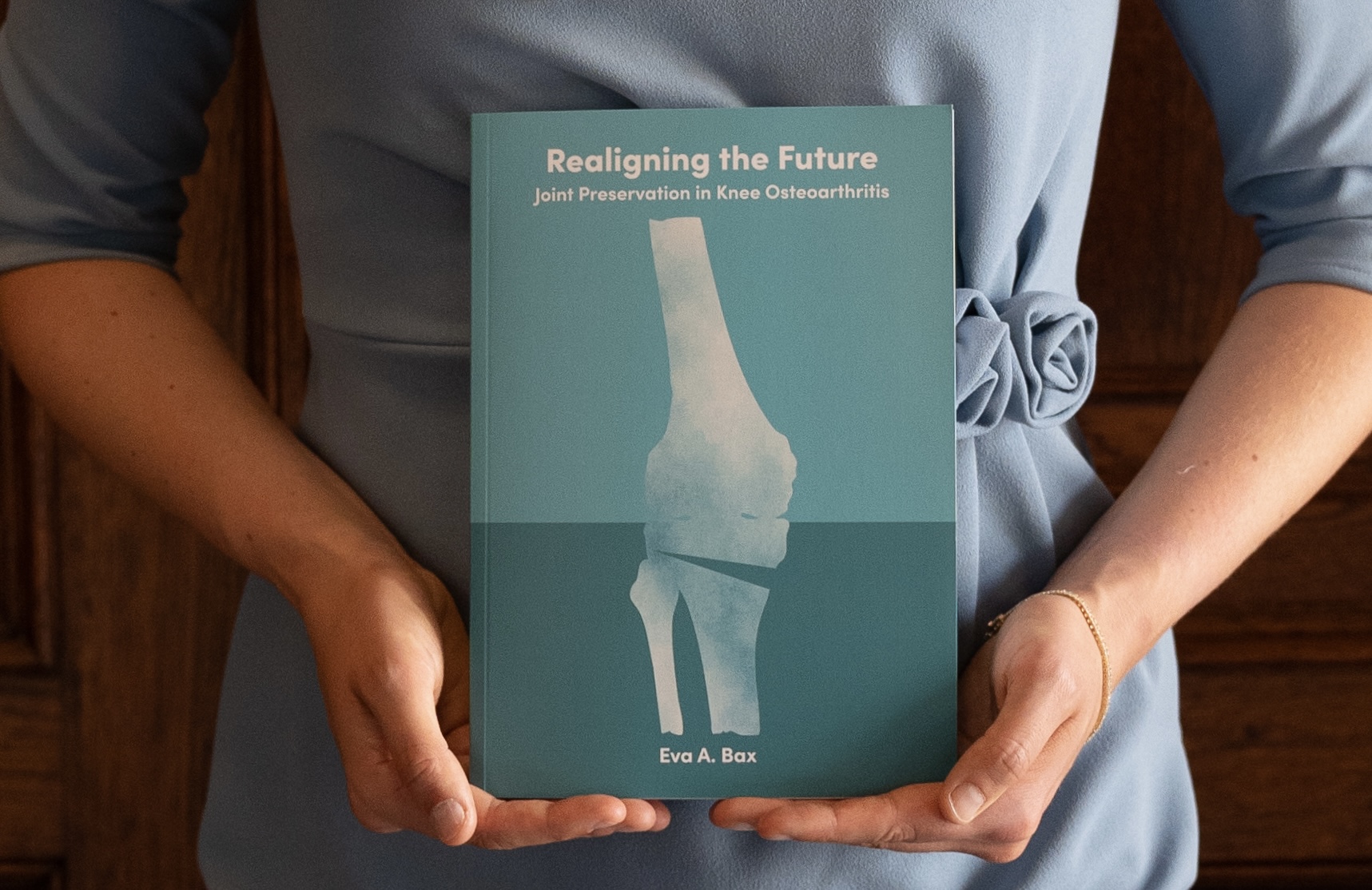
In 2020, nearly 100 million people under the age of 55 worldwide had knee osteoarthritis, and this number is rising rapidly. Although knee replacement surgery is often considered the standard solution, younger patients may benefit from leg alignment correction surgery, which shifts pressure away from the damaged part of the knee. On 16 June, Eva Bax defended her PhD thesis at UMC Utrecht, in which she investigated how care surrounding this procedure can be further optimized to improve outcomes for patients with knee osteoarthritis.
Knee osteoarthritis is characterized by damage to the cartilage in the knee joint, which can lead to pain, stiffness, and limitations in daily life. Although the condition is often associated with older age, it also affects many younger people. For these patients, the impact can be substantial as work, sports, and other everyday activities become more difficult.
In cases of severe knee osteoarthritis, surgeons often replace the damaged knee with a prosthetic joint. “For older patients, this is usually an effective treatment,” says Eva Bax, PhD candidate at the Department of Orthopaedic Surgery at UMC Utrecht. “For younger patients, however, the situation is different.”
A prosthetic knee has a limited lifespan. The younger a patient is at the time of implantation, the greater the likelihood that the prosthesis will need to be replaced later in life. Such revision surgery is invasive and often technically more complex than the initial procedure. In addition, younger patients tend to be less satisfied with the outcome. “That is why we are looking for ways to postpone knee replacement surgery for this group for as long as possible,” Bax explains.
One way to achieve this is by addressing the underlying cause of the symptoms. In her PhD research, Bax therefore focused on younger patients with knee osteoarthritis who also had knee malalignment. This means that the leg is not perfectly straight, as in bow legs or knock knees. As a result, the pressure across the knee joint is distributed unevenly, which can contribute to the development of knee osteoarthritis.
Realigning the leg (osteotomy) can help relieve symptoms by redistributing the load within the joint. “Although the osteoarthritis itself does not disappear, this reduces the pressure on the painful part of the joint,” Bax explains. “As a result, many patients experience less pain and are better able to resume their daily activities.”
In about 75 percent of the cases, an alignment correction can delay the need for a knee replacement by as much as 10 years—or even prevent it altogether. “If a patient develops knee osteoarthritis at the age of 50, you would prefer not to replace the knee with a prosthesis. If that same patient eventually needs a knee replacement at the age of 65, that is a very different situation.”
Delaying knee replacement surgery may sound appealing, but orthopedic surgeons have long questioned this approach. There is concern that a previous alignment correction could make a future knee replacement technically more challenging and potentially lead to poorer outcomes.
Bax’s research did not support those concerns: “We found no significant differences in outcome between patients who first underwent an alignment correction and later required a knee replacement, and those who received a knee replacement without prior alignment correction.”
Maximizing those outcomes, however, requires that the bone heals properly after surgery. “We monitor that on X-rays, but there was no standardized way to do so,” says Bax. “We therefore developed a scoring system to assess bone healing in a consistent way.” Her research group is also investigating whether filling the surgical gap with a synthetic ceramic material can accelerate bone healing. “This could further improve recovery and outcomes for patients.”
Knee problems affect millions of people and can take over a person’s life. Roel Custers, orthopedic surgeon and researcher at UMC Utrecht, has dedicated his career to changing that. With his recent appointment as associate professor, a new chapter begins. One of expanded research, greater visibility, and the hope of reaching more patients.
Following the completion of her PhD, Bax remains at UMC Utrecht as a postdoctoral researcher. Looking back on her doctoral journey, she is particularly proud of the freedom she gave herself to pursue her own scientific questions, supported by the trust and confidence of her team. “During my PhD, I learned that it is important to follow your own vision,” she says. “That helped me conduct research that I truly believe in.”
In the future, Bax hopes not only to improve the treatment of knee osteoarthritis but also to prevent it. “My dream is that one day we will be able to identify which patients are at risk, allowing us to intervene earlier and perhaps even prevent the condition from developing.”
She acknowledges that this may still sound like a distant goal. “But if we gain a better understanding of the factors that contribute to the development of osteoarthritis, we may be able to help patients before the first symptoms even appear. I hope that this may still happen during my career.”