
Pain arises as a result of a complex interaction between the nervous system and the immune system. Our research focuses on investigating various mechanisms that are important for this interaction to function optimally, thereby reducing the risk of chronic pain or even treating chronic pain. If the communication between nerve cells and immune cells is not functioning properly, chronic pain can develop. We want to gain a better understanding of how the interaction between nerves and the immune system helps to stop pain, what goes wrong in the case of long-term pain, and show that we can influence this cooperation to relieve pain.
We specifically investigate the interactions of nervous cells and immune cells in acute, inflammatory pain and chronic pain, such as osteoarthritis pain and diabetic neuropathy. To investigate these mechanisms, we combine in vivo and in vitro models.
Our ongoing projects:
1. Immune regulation of pain resolution
Resolution of inflammatory pain is an active process that depends on immune cells. Macrophages are essential to resolve pain after inflammation, and one of the mechanisms they help to resolve pain is through transfer of their mitochondria to sensory neurons. Without macrophages, pain becomes chronic, while inflammation is cleared. In addition, we found a role for the inhibitory immune receptor CD200R. Macrophages that do not express CD200R cannot resolve pain.
We now aim to understand the mechanism that CD200R-expressing macrophages use to resolve pain and the signals that neurons transmit to attract immune cells for pain resolution. Additionally, we research the potential role of other inhibitory receptors in pain. We hope to use this knowledge to, in the future, find a cure for chronic inflammatory pain.
In this project, we collaborate with the Inhibitory Receptor Lab (https://inhibitoryreceptorlab.nl). This project is led by Femke de Krom and Marije Voskamp (Inhibitory Receptor Lab)
2. Extracellular vesicles in pain
This project investigates the endogenous molecular pathways governing pain resolution. The central aim of the project is to understand how neuronal metabolism is reprogrammed to resolve inflammatory pain, and what is the role of immune system in this process. A key area of interest is the role of macrophages, which support neuronal recovery by transferring mitochondria to sensory neurons via extracellular vesicles. These vesicles contain molecular components that promote pain resolution. By uncovering the mechanisms behind metabolic reprogramming, vesicle-mediated communication, and mitochondrial dynamics, this project aims to identify novel therapeutic targets for the treatment of chronic inflammatory pain.
This project is led by Valeria Spanu, Judith Prado and Sander van der Ven
3. Bone pain
As part of the BonePain III network, we research neuro-immune interactions behind bone pain, specifically osteoarthritis pain. Pain in osteoarthritis is poorly related to the level of tissue damage and often persists even after total knee replacement, Thus, treatment options for patients are limited and often ineffective. Our research focuses on investigating the mechanisms behind osteoarthritis pain, with a specific interest in metabolism and finding ways to boost bone pain resolution using novel, non-opioid therapeutics.
This project is led by Virginia Vergani and Muriel Zanicolo
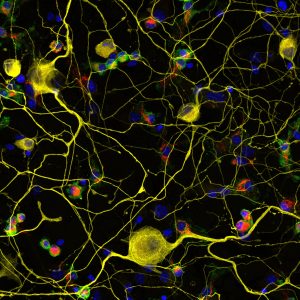
Picture show a co-culture of neuronal cells with immune cells (macrophages)
Press play to start the video.